
Fear Sells: How Salespeople Can Use the Fear of Loss
Any marketing person will tell you that sex sells.
Well, we're here to tell you that sex doesn't necessarily sell. Sex gets your attention.
Once you have someone's attention, something else has to motivate them to actually buy.
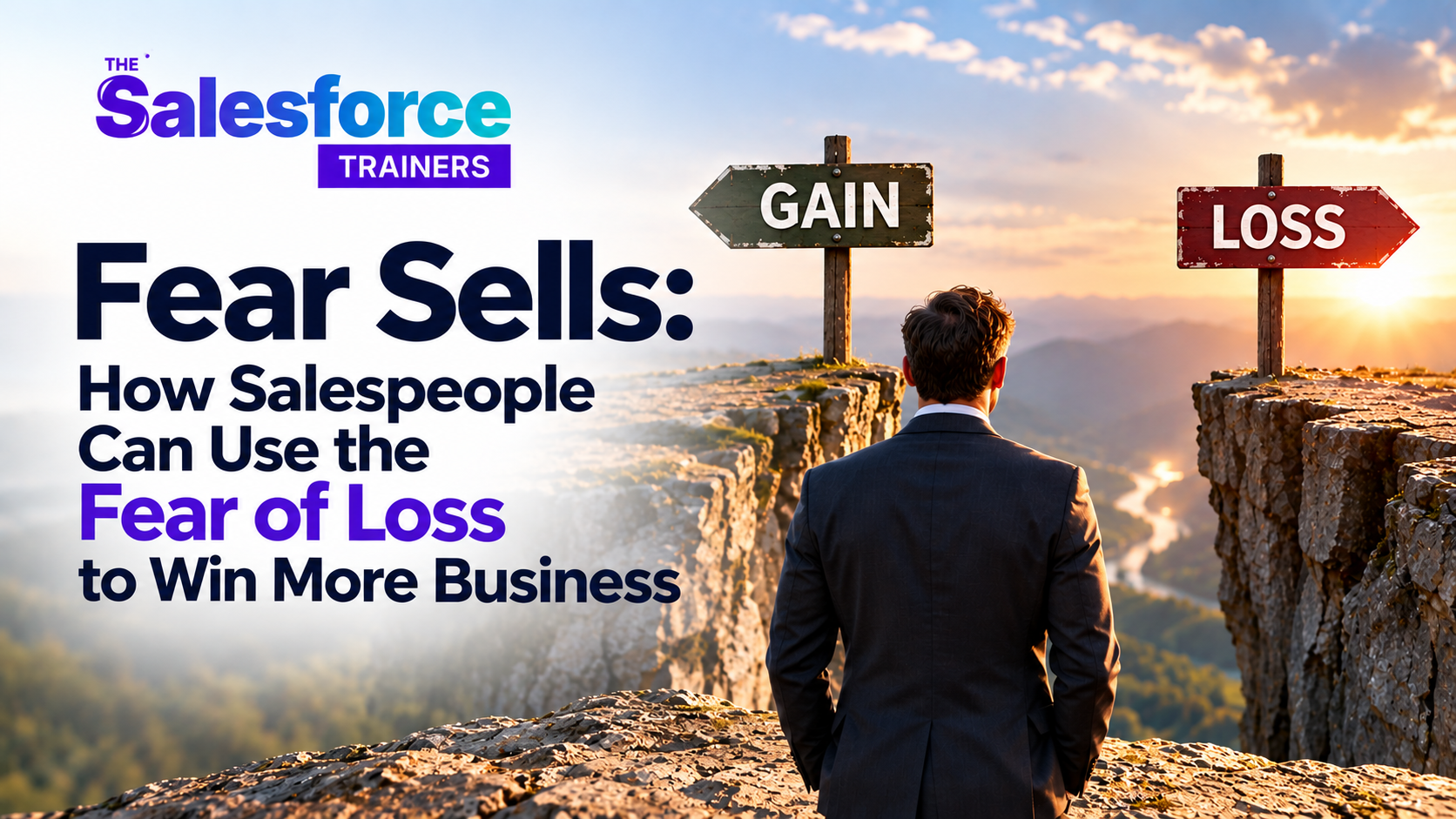
Two of the most important buying motives are the desire for gain and the fear of loss.
And many salespeople instinctively rely on the first one.
"We'll help you increase revenue."
"You'll save money."
"Your salespeople will close more business."
"Your company will become more productive."
All of those are perfectly legitimate benefits.
But there's another way to frame the conversation:
What happens if you don't make a change?
That's where the fear of loss comes in.
And there's an important distinction to make right from the beginning:
Using the fear of loss isn't the same thing as manipulating someone with fear.
The objective isn't to frighten a prospect into buying something they don't need.
It's to help them understand the consequences of maintaining the status quo when those consequences are real and relevant.
The Desire for Gain vs. the Fear of Loss
Most purchases involve some degree of risk.
The prospect has to decide whether the potential benefit of making a change is worth the risk of making that change.
A salesperson might emphasize the potential gain:
"You could save $100,000 a year."
Or they might frame the same situation around potential loss:
"You're currently spending $100,000 a year that you don't need to spend."
The underlying economics may be similar.
But psychologically, the two statements can feel very different.
This is where the work of researchers Amos Tversky and Daniel Kahneman becomes relevant.
Why People Often Fear Loss More Than They Desire Gain
Tversky and Kahneman conducted influential research into how people make decisions involving risk.
One of the classic examples presents people with two scenarios.
In the first, you're given $1,000 and must choose between:
- A guaranteed additional gain of $500
- A 50% chance of gaining another $1,000 and a 50% chance of gaining nothing
Most people choose the guaranteed $500.
Now consider the second scenario.
You're given $2,000 and must choose between:
- A guaranteed loss of $500
- A 50% chance of losing $1,000 and a 50% chance of losing nothing
In this scenario, more people are willing to take the gamble.
The financial outcomes are mathematically equivalent.
But the way the choice is framed changes the way people respond to it.
The important sales lesson is straightforward:
People can be more motivated to avoid a loss than to pursue an equivalent gain.
That's a powerful concept for salespeople to understand.
But it needs to be used carefully.
Using Fear Doesn't Mean Manipulating the Buyer
There's a big difference between motivation and manipulation.
If you tell a prospect they're going to lose everything unless they buy your product today, when you know that's not true, that's manipulation.
If you help a prospect understand a genuine business risk they've been overlooking, that's something different.
The difference is truth.
The risk you're discussing should be:
- Real
- Relevant to the prospect
- Supported by evidence
- Something the prospect can actually address
- Proportionate to the decision
In other words, don't manufacture fear.
Uncover it.
That's one of the fundamental principles of consultative selling: understand the customer's situation before recommending a solution.
If you want to explore that approach further, see Stop Selling and Start Consultative Selling.
Insurance Has Been Using Fear for Years
The insurance industry has long understood the power of the fear-of-loss motivator.
Think about the classic insurance conversation:
"What would happen to your family if you were no longer here?"
The salesperson isn't really selling a policy.
They're helping the prospect think about a potential loss that they may prefer not to contemplate.
Advertising uses the same principle.
Consider the famous Michelin tire advertising featuring a baby sitting inside a tire.
They're obviously not selling babies.
They're selling the idea of protecting something precious.
The underlying message is about risk:
What could happen if you don't protect what matters?
The best examples don't need to scream "FEAR!"
They simply make the potential consequence visible.
Put the Fear of Loss to Work
So how can salespeople actually use this concept?
Start with your existing benefit statements.
Take the traditional desire-for-gain statement and ask:
What is the corresponding cost of doing nothing?
Here are some examples.
Sales Training
Desire for gain:
"Your salespeople will be able to close more sales."
Fear of loss:
"How many opportunities might your team continue to lose because they're repeating the same ineffective sales behaviors?"
The second question doesn't promise a result.
It creates a conversation about the cost of leaving the problem unresolved.
That's a much more useful sales conversation.
If you're responsible for developing those behaviors, our Salesforce Training Academy provides instructor-led training designed around practical sales skills and application.
Financial Planning
Desire for gain:
"We can help you reduce your taxes."
Fear of loss:
"Are you paying more tax than necessary and reducing the amount of money available to accomplish your financial goals?"
Again, the point isn't to frighten the prospect.
It's to make the cost of inaction visible.
Digital Advertising
Desire for gain:
"Advertising will increase the number of leads available to your sales team."
Fear of loss:
"What happens to your pipeline if your competitors are generating demand while you're not?"
Now the prospect has to think about the consequences of doing nothing.
Employee Benefits
Desire for gain:
"An attractive benefits package can help you recruit employees."
Fear of loss:
"How many good candidates could you lose if your benefits package isn't competitive?"
The potential loss is directly connected to the business problem.
Data Backup
Desire for gain:
"This backup system protects your important data."
Fear of loss:
"What would it cost your business if you lost critical data and several days of productivity?"
Again, we're not inventing a problem.
We're helping the prospect quantify an existing risk.
The Sales Exercise: Find the Cost of Doing Nothing
Here's an exercise you can use with your sales team.
Take your product or service's fact-and-benefit sheet.
For every major benefit, ask:
"What does the customer stand to lose if they don't have this?"
For example:
Benefit:
"Our system gives sales managers better visibility into their pipeline."
Potential loss:
"Without reliable pipeline visibility, how much revenue could be at risk because managers don't see stalled opportunities early enough?"
That's a much more interesting conversation.
And notice what happened.
We didn't invent a threat.
We didn't tell the prospect that disaster was inevitable.
We simply asked them to consider the consequences of the status quo.
Don't Turn Every Sales Conversation Into a Fear Campaign
There's a danger here.
If every conversation becomes:
"Buy this or something terrible will happen!"
you'll quickly lose credibility.
Fear of loss is one buying motive, not the only one.
Sometimes the prospect really is motivated by the upside.
Sometimes they're trying to solve an immediate problem.
Sometimes they're looking for a competitive advantage.
And sometimes they're perfectly comfortable with the status quo.
A good salesperson figures out what actually matters to the buyer rather than forcing every prospect into the same sales formula.
That's why effective sales training should teach salespeople how to diagnose before they prescribe.
Use Fear to Create Urgency—Not Pressure
One of the most useful applications of the fear-of-loss concept is creating legitimate urgency.
A prospect might agree that your solution would benefit them but still have no reason to act today.
That's where a good salesperson can ask:
"What happens if you don't address this?"
Or:
"What's the cost of leaving this problem as it is for another six months?"
Or:
"What happens to your business if nothing changes?"
Those questions can uncover urgency that was already there.
They don't manufacture urgency.
They reveal it.
That's an important distinction.
The Best Salespeople Understand Both Sides of the Equation
Great salespeople don't simply memorize a collection of techniques for making people buy.
They understand how their customers make decisions.
They can articulate the potential gain.
They can uncover the potential loss.
They can help the customer understand the consequences of both action and inaction.
And then they let the customer make an informed decision.
That's particularly important in consultative selling.
The salesperson's job isn't to create artificial pressure.
It's to help the buyer understand the business problem well enough to make a good decision.
Now It's Your Turn
Take your product or service and look at your most important benefits.
For each one, ask yourself:
What does the customer gain by buying from us?
Then ask the more difficult question:
What might the customer lose by doing nothing?
You may discover that some of your strongest sales messages have been sitting right in front of you.
But don't expect the exercise to be easy.
And please don't put your product in the middle of a Michelin tire and hope for the best.
Although, if it works, I want to hear about it.
Fear Can Motivate. Trust Closes the Sale.
The fear of loss can be a powerful sales motivator.
But it has to be used responsibly.
The goal isn't to scare someone into buying.
The goal is to help them understand the real consequences of their current situation.
If the prospect faces a genuine risk, ignoring that risk doesn't help anyone.
If there is no meaningful risk, inventing one is simply manipulation.
The best salespeople understand the difference.
Motivation helps a buyer make a mutually beneficial decision. Manipulation tries to make the buyer do what benefits the seller.
So use all the tools available to you.
Talk about the upside.
Understand the downside.
Ask what happens if nothing changes.
And above all, make sure the fear you're discussing is real.
Don't sell fear. Help your customer understand the cost of ignoring the problem.
Originally published in SalesForce Targets, by Brian Jeffrey, founder of SalesForce Training & Consulting.
Want to build sales skills that actually change behavior? Explore the Salesforce Training Academy or learn about Custom Salesforce Training built around your team's sales process.