The Most Important Metrics in Salesforce: Leading Indicators
Sales leaders have access to more sales data than ever.
Revenue. Pipeline. Win rate. Average deal size. Sales cycle. Forecast. Activities. Meetings. Calls. Opportunities. Conversion rates.
The problem isn't finding something to measure.
The problem is knowing which metrics actually tell you what needs to happen next.
That's where leading indicators come in.
Revenue and closed business tell you what happened. Leading indicators tell you what your salespeople are doing today that is likely to influence the results you'll see tomorrow.
And that's where Salesforce can become incredibly powerful — not simply as a place to record sales activity, but as a system for measuring the behaviors that drive your sales process.
Start With the Sales Outcome You Want
Before you configure Salesforce, start with a much more basic question:
What does a successful salesperson actually do?
Every sales organization is different.
A business with a short transactional sales cycle may need a very different set of activities than an organization selling complex enterprise solutions.
One company may need salespeople generating a certain number of new discovery meetings every week.
Another may need account managers conducting regular executive reviews with existing customers.
Another may need a certain number of qualified opportunities created each month.
Another may need proposals or quotes generated within a defined period after discovery.
The point is that you shouldn't start with Salesforce.
Start with the sales process.
Identify the behaviors that you believe consistently contribute to successful selling. Then determine which of those behaviors are measurable.
That gives you your leading indicators.
And once you've identified them, Salesforce can become the system you use to measure and manage them.
Leading Indicators vs. Lagging Indicators
This distinction is critical.
A lagging indicator tells you what already happened.
Revenue is a lagging indicator.
Closed-won opportunities are a lagging indicator.
Quota attainment is a lagging indicator.
Those numbers matter, but your sales team can't go back in time and change them.
A leading indicator, on the other hand, gives you visibility into the activities or behaviors that are likely to influence future results.
For example:
- New discovery meetings
- Qualified opportunities created
- Customer meetings
- Executive meetings
- Proposals delivered
- Follow-up activities completed
- Opportunities progressing through defined stages
The exact metrics will vary by organization.
What matters is that you identify the activities that have a meaningful relationship to your sales process and then measure them consistently.
Here's the important part:
Don't confuse activity with productivity.
If you tell a salesperson that they need to make 50 calls a week, you may get 50 calls.
That doesn't necessarily mean you'll get better sales results.
The real question is whether those activities are the right activities, performed with the right level of quality, at the right point in the sales process.
That's where sales management comes in.
How Many Is Enough?
Once you've identified an important activity, establish a reasonable target.
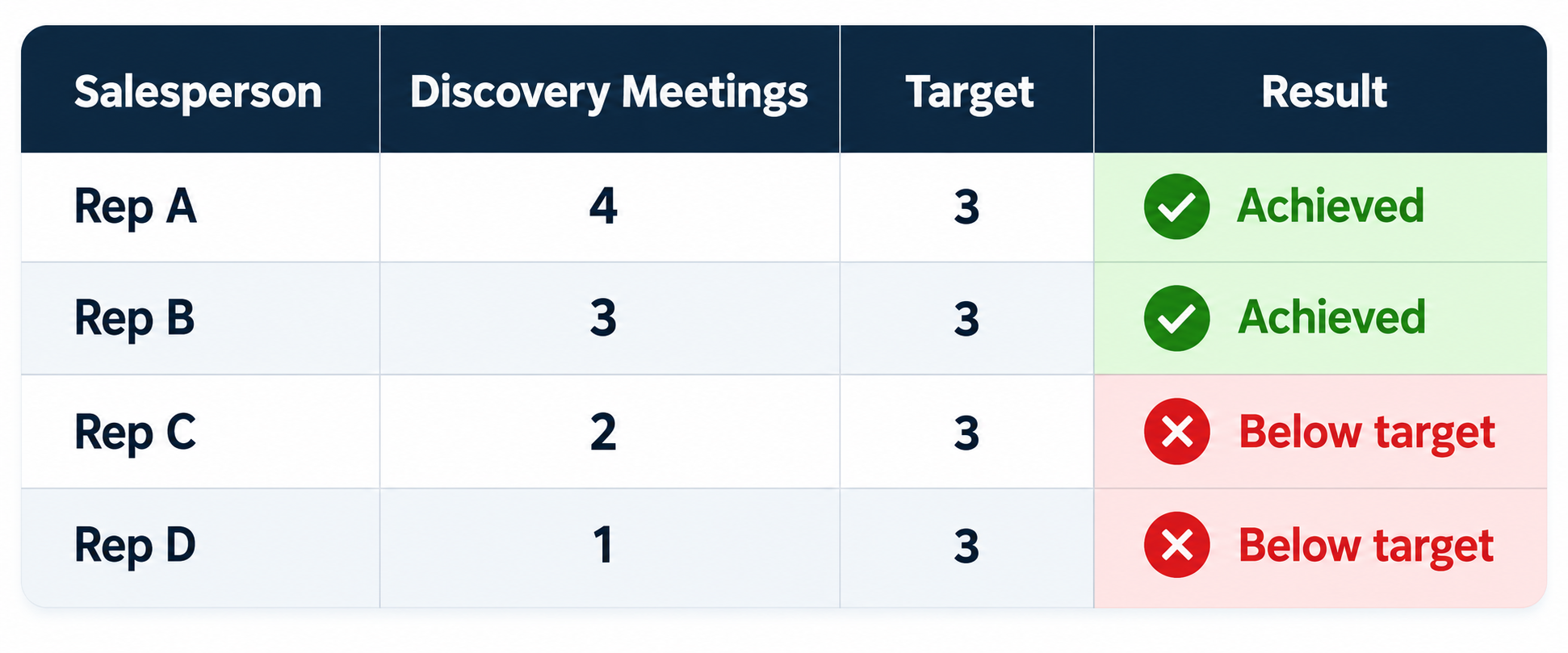
Let's say your sales organization determines that an effective salesperson should generate three new discovery meetings per week.
Now you have something that can be measured.
At the end of the week:
- Zero meetings? The target wasn't met.
- One? The target wasn't met.
- Two? Close, but still below target.
- Three? Target achieved.
- Four or five? Interesting. Let's understand why.
That last point is important.
More isn't automatically better.
If someone generates seven discovery meetings when the expected number is three, that's worth investigating.
Were they all legitimate prospects?
Were the meetings properly prepared for?
Were they quality conversations?
Did the salesperson have enough time to follow up properly?
A good sales metric isn't simply about maximizing volume.
It's about identifying the level of activity that gives your salespeople the best opportunity to produce the desired result.
Salesforce Makes This Much Easier
This is where Salesforce becomes particularly useful.
Salesforce Activities — including Log a Call, Tasks and Events — give you a place to capture many of the activities your salespeople are already performing.
But there's an important distinction between recording an activity and making that activity useful as a management metric.
Suppose your sales team logs hundreds of calls every week.
That's data.
But if your sales manager wants to know:
How many first-time discovery meetings did each salesperson have this week?
the standard activity information may not be enough.
That's where thoughtful Salesforce configuration comes in.
Salesforce Platform Optimization
Add Context to Your Salesforce Activities
One practical approach is to add a custom picklist to your Salesforce Activities that identifies the type of KPI or leading indicator associated with the activity.
For example:
KPI / Leading Indicator
- New Discovery Meeting
- Existing Customer Meeting
- Executive Meeting
- Proposal Review
- Account Review
Not every Task or Event needs to be classified as a KPI.
That's important.
Your salespeople will have plenty of activities that are necessary but aren't part of the specific metrics you're using to manage sales performance.
The purpose isn't to turn every activity into a KPI.
The purpose is to make the important activities measurable.
Once you've done that, Salesforce can report on them.
Build the Report Your Sales Managers Actually Need
Now you can create an Activities report that shows the KPI-related activities by salesperson.
Instead of asking:
"How busy is everyone?"
your sales manager can ask:
"Are the activities we believe drive sales actually happening?"
That's a much better management question.
You can organize the report by salesperson and examine activity against the established target.
For example:
 Now you've moved from data collection to sales management.
And that's the distinction that matters.
Don't Turn This Into Micromanagement
This is where sales leaders sometimes get uncomfortable.
I've heard sales managers say:
"I don't want to micromanage my team."
Fair enough.
But measuring a handful of meaningful sales activities isn't automatically micromanagement.
It becomes micromanagement when the manager focuses on activity for activity's sake.
Good sales management is different.
The manager is looking at the information and asking:
- Are the right activities happening?
- Are they happening consistently?
- Are they producing the expected results?
- Where is someone struggling?
- What coaching does this salesperson need?
- Is there something wrong with the sales process?
- Is the target itself realistic?
The metric isn't the management.
The conversation that the metric enables is the management.
Use the Metric to Coach, Not Punish
Let's go back to our salesperson who had two discovery meetings when the target was three.
The wrong conversation is:
"You only had two meetings. You need to do better."
That's not coaching.
A better conversation is:
"I noticed you had two discovery meetings this week. Walk me through what happened."
Maybe the salesperson had a legitimate reason.
Maybe they spent too much time on an existing opportunity.
Maybe their territory has changed.
Maybe marketing didn't deliver the expected leads.
Or maybe they're simply not spending enough time creating new opportunities.
You won't know until you have the conversation.
And that's the real value of the metric.
It gives the sales manager something objective to inspect and coach.
This is also why we put so much emphasis on the people side of Salesforce adoption. A metric only becomes useful when managers actually use it to change behavior.
Salesforce Adoption & Change Management
The Metric Doesn't Replace Judgment
This is another area where Salesforce can be misused.
It's tempting to believe that if you can measure something, you can manage it automatically.
You can't.
A Salesforce report can tell you that a salesperson had three discovery meetings.
It can't necessarily tell you whether those were good discovery meetings.
It can tell you that an Opportunity moved from one stage to another.
It can't tell you whether the deal actually deserved to move.
It can tell you that an activity was logged.
It can't tell you whether the salesperson had a productive conversation.
That's why good sales management still requires inspection, observation and coaching.
The data gives you the starting point.
The manager provides the judgment.
Your Salesforce Metrics Should Reflect Your Sales Process
This is the piece I think gets missed most often.
Don't begin by asking:
"What Salesforce metrics should we track?"
Begin with:
"What does our sales process require our salespeople to do?"
Then ask:
"Which of those behaviors can we measure?"
Then:
"Which of those measurements actually help our managers coach performance?"
Only then should you configure Salesforce.
That's the proper sequence:
Sales Strategy → Sales Process → Sales Behaviors → Metrics → Salesforce
Not the other way around.
You shouldn't configure Salesforce first and then try to figure out what your salespeople should be doing.
That's the philosophy behind our Process, Platform and People approach to Salesforce.
And Don't Track Too Many Metrics
One of the easiest mistakes to make is creating too many KPIs.
Before long, your sales dashboard has 25 metrics on it.
Then 30.
Then 40.
And suddenly nobody knows which numbers actually matter.
If everything is a KPI, nothing is a KPI.
I'd rather see a sales organization identify three or four genuinely important leading indicators and manage them consistently than create a dashboard containing every possible measurement Salesforce can produce.
Your salespeople should know:
- What we're measuring.
- Why we're measuring it.
- What the target is.
- How it connects to our sales process.
- What their manager is going to do with the information.
That's how a metric becomes useful.
Salesforce Should Help Your Managers Manage
This is ultimately what I want Salesforce to do for a sales organization.
Not simply collect information.
Not simply produce dashboards.
And certainly not create more administrative work for salespeople.
Salesforce should give sales managers better visibility into what is actually happening in their teams.
If you know which activities drive your sales process, you can measure them.
If you can measure them, you can inspect them.
If you can inspect them, you can coach them.
And if you can coach the right behaviors consistently, you have a much better chance of improving the results that follow.
That's the real opportunity.
Don't use Salesforce to measure everything. Use Salesforce to measure what matters.
And remember: the most important sales metric isn't necessarily the number that tells you what happened.
It's often the leading indicator that tells you what needs to happen next.