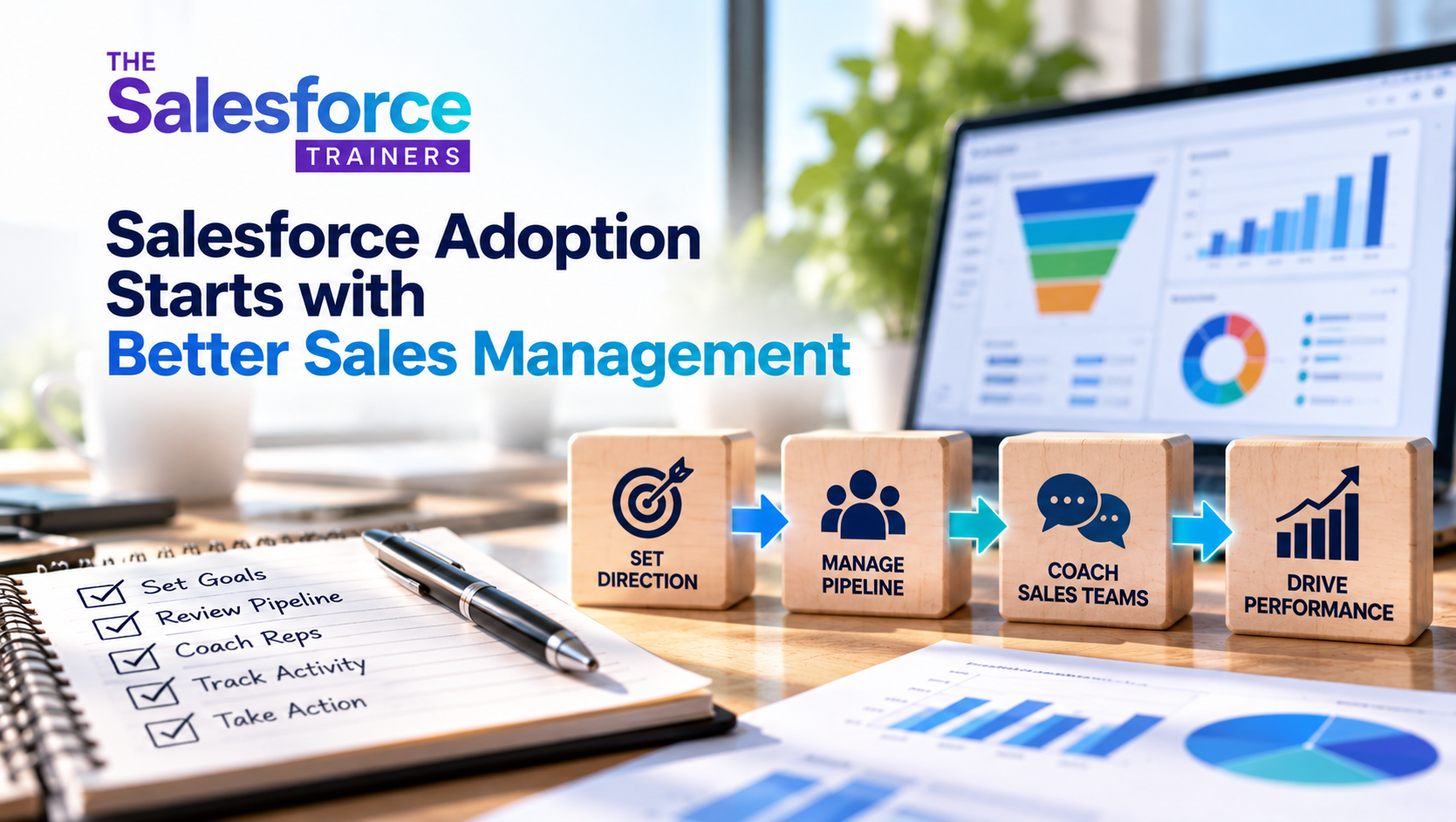
Underperforming Reps: How Salesforce Helps Sales Managers

Sales management is tough.
Your job is to get the most out of a group of people who themselves have a challenging job. You're responsible for the number, but you're also responsible for developing the people who are supposed to produce that number.
And not every salesperson is going to perform at the same level.
Some will consistently exceed expectations.
Some will perform reasonably well but have room to improve.
And some will struggle.
The real question for a sales manager isn't simply:
“Who isn't performing?”
It's:
“Why aren't they performing, and what am I going to do about it?”
That's where Salesforce can become incredibly useful.
Not because Salesforce can manage your salespeople for you.
It can't.
But it can give you the visibility you need to identify problems earlier, have better coaching conversations, and hold people accountable to the expectations you've established.
Salesforce Gives You Visibility Into Sales Performance
One of the biggest advantages of running your sales organization in Salesforce is that you don't have to rely entirely on what your salespeople tell you is happening.
You can look at the data.
Is the salesperson creating enough new opportunities?
Are their Opportunities progressing?
Are close dates being pushed repeatedly?
Are next steps being entered?
Are activities being recorded?
Is their pipeline large enough to support their target?
Are deals sitting in the same stage for weeks or months?
Is their forecast changing every time you have a pipeline meeting?
Those aren't necessarily signs of poor performance by themselves.
But they're signals.
And good sales managers learn to recognize the difference between a signal that deserves investigation and a problem that requires action.
Don't Manage the Number. Manage the Behaviors Behind It.
This is one of the biggest mistakes I see in sales management.
A salesperson misses their number, so the manager tells them:
"You need to sell more."
Well, yes.
That's technically true.
It's also completely useless.
The better question is:
What behaviors are contributing to the performance problem?
Maybe the salesperson isn't generating enough new opportunities.
Maybe they're spending too much time on low-value accounts.
Maybe their discovery meetings aren't producing qualified opportunities.
Maybe their pipeline isn't large enough.
Maybe they're creating opportunities but not progressing them.
Maybe they're not following up consistently.
Maybe they're struggling with a particular part of the sales process.
Or maybe the target itself isn't realistic given the territory, market or resources they've been given.
You won't know until you look.
And that's where Salesforce becomes a management tool rather than simply a CRM.
Salesforce Platform Optimization
Start With Your Sales Process
Before you decide that someone is a poor performer, you need to know what good performance actually looks like.
That sounds obvious.
It isn't.
If your sales organization doesn't have a clearly defined sales process, your managers may have very different ideas about what their salespeople should be doing.
One manager may expect an Opportunity to be created early.
Another may not want an Opportunity created until there's a confirmed buying process.
One manager may consider an Opportunity healthy because the salesperson has had a meeting.
Another may expect a defined next step, identified decision makers, a compelling business problem and a realistic close date.
If everyone has a different definition of a healthy Opportunity, your Salesforce data isn't going to give you consistent management information.
You can't hold people accountable to a standard that hasn't been defined.
That's why sales performance management starts with the sales process.
Use Salesforce to Spot the Signals
Once your sales process is defined, Salesforce can help you identify the behaviors and conditions that deserve attention.
For example:
Pipeline Creation
Is the salesperson creating enough qualified pipeline to support their target?
A salesperson who consistently has too little pipeline may have a prospecting problem long before they have a revenue problem.
Opportunity Progression
Are Opportunities moving through the sales process?
If a salesperson has twenty Opportunities but most of them haven't moved in weeks, the size of the pipeline may be misleading.
Stale Opportunities
How many Opportunities have close dates that have passed?
How many haven't had a meaningful update recently?
A large pipeline full of stale Opportunities isn't necessarily a healthy pipeline.
Next Steps
Does every active Opportunity have a clear next step?
If not, you may have a process or sales-execution problem that needs to be addressed.
Activity
Are the activities that matter actually happening?
Calls, meetings, follow-ups and other leading indicators can give managers visibility into what salespeople are doing before the revenue results appear.
None of these metrics tells you why something is happening.
That's the manager's job.
But they give you somewhere to start.
Don't Confuse Activity With Performance
This is important.
Salesforce makes it easy to count things.
Calls.
Emails.
Meetings.
Tasks.
Opportunities.
But more activity doesn't automatically mean better performance.
A salesperson can make fifty calls and produce nothing.
Another salesperson can make ten calls and generate two excellent opportunities.
So don't build a management system around activity for activity's sake.
Instead, identify the leading indicators that actually matter to your sales process.
Then use Salesforce to help managers see whether those behaviors are happening.
The purpose of the data isn't to prove that someone is busy.
It's to help you understand whether they're doing the things that give them the best opportunity to succeed.
Your Salesforce Data Is Only as Good as Your Sales Process
There's a catch, though.
Salesforce doesn't magically create good management information.
If your salespeople aren't updating Opportunities, your pipeline report isn't telling you what's actually happening.
If your stages aren't clearly defined, stage reporting becomes questionable.
If close dates aren't maintained, your forecast becomes unreliable.
If managers don't use Salesforce consistently, the team quickly learns that the information in the system isn't particularly important.
And once that happens, you've got an adoption problem.
That's why Salesforce adoption isn't simply about getting people trained on the software.
People need to understand how Salesforce fits into the way they sell — and managers need to consistently use the information in Salesforce to manage the business.
Salesforce Adoption & Change Management
Your Team Watches What You Tolerate
This is one of the most important ideas from the original article, and I think it's worth keeping.
When managers repeatedly allow poor performance without addressing it, they're sending a message to the entire team.
Not necessarily intentionally.
But the message is still there.
If one salesperson consistently fails to update Salesforce and nothing happens, other people notice.
If someone repeatedly misses agreed-upon commitments and there is no follow-up, other people notice.
If a salesperson consistently carries stale Opportunities and nobody challenges them, other people notice.
And eventually the behavior becomes normalized.
What you tolerate becomes part of your sales culture.
That's why accountability isn't just about the individual salesperson who is struggling.
It's about the standards you're establishing for the entire team.
Accountability Doesn't Mean Punishment
This is another distinction that matters.
Accountability isn't about catching people doing something wrong.
It's about making expectations clear and then consistently following up on them.
A good manager should be able to say:
"Here's what we agreed would happen."
"Here's what I'm seeing."
"Help me understand the gap."
That's a much more productive starting point than:
"Why aren't you doing your job?"
Maybe there's a legitimate obstacle.
Maybe the salesperson doesn't understand the expectation.
Maybe they need training.
Maybe they need coaching.
Maybe there's a territory problem.
Maybe there's a process problem.
Or maybe they simply aren't doing what they've agreed to do.
You need to find out.
Coach Before You Conclude
When a salesperson isn't performing, my first instinct wouldn't be to start thinking about replacing them.
I'd start with a conversation.
A simple three-step approach works well:
1. What is the problem?
Get agreement on what isn't working.
Don't assume that you and the salesperson see the problem the same way.
2. What is causing it?
Ask questions and listen.
Maybe the salesperson knows exactly what's getting in their way.
Maybe they need additional skills.
Maybe their approach isn't working.
Maybe something outside their control is contributing to the problem.
3. What are we going to do about it?
Work with the salesperson to establish specific actions.
What needs to change?
By when?
How will you know it's improving?
What support do they need from you?
And when are you going to review the results?
This turns a vague performance problem into something you can actually manage.
Salesforce Can Make the Coaching Conversation Better
This is where I think Salesforce is particularly powerful for sales managers.
Imagine going into a one-on-one with a salesperson and saying:
"Your numbers aren't good enough."
Now compare that with:
"You've created eight Opportunities this quarter, but only two have progressed beyond Discovery. You've also got six Opportunities with close dates in the past. Let's look at what's happening."
That's a completely different conversation.
The second conversation is based on evidence.
And evidence gives both the manager and the salesperson something concrete to work with.
Salesforce doesn't replace the coaching conversation.
It makes the coaching conversation better.
That's an important distinction.
Don't Manage Salesforce From the Sidelines
There's another mistake sales managers make.
They expect Sales Ops or the Salesforce administrator to be responsible for adoption.
They're not.
Your Salesforce administrator can configure the system.
Sales Ops can build reports.
Your implementation partner can train your people.
But the sales manager is the person who makes Salesforce part of the way the team actually operates.
If Salesforce is used during pipeline reviews, one-on-ones, forecast meetings and coaching conversations, salespeople quickly understand that it matters.
If nobody looks at Salesforce until someone from Sales Ops asks for a report, the message is very different.
That's why we believe sales managers play such a critical role in Salesforce adoption.
ProSell Salesforce Training & Adoption Program
What About the Salesperson Who Still Doesn't Improve?
Sometimes you've done the right things.
You've made the expectations clear.
You've provided training.
You've coached.
You've provided support.
You've given the salesperson a reasonable opportunity to improve.
And the performance still doesn't change.
That's when the conversation becomes different.
At that point, the manager needs to make a difficult decision about whether the salesperson can realistically meet the expectations of the role.
That doesn't mean jumping immediately to termination.
It means recognizing that accountability has to have a consequence.
If you've established reasonable expectations and consistently supported the salesperson in meeting them, there eventually comes a point where continuing to accept the same level of performance isn't fair to the rest of the team, the business, or the salesperson.
The original article called this “salvage first, replace second.” I think that's still a useful philosophy — provided “salvage” means genuinely coaching and supporting someone toward a clearly defined standard, rather than indefinitely tolerating performance that isn't meeting the requirements of the role.
The Best Sales Managers Use Salesforce as a Management System
This is ultimately what Salesforce should become for a sales organization.
Not just a database.
Not just a place where salespeople are required to enter information.
Not just a reporting system for Sales Ops.
A management system.
A system that helps managers understand:
- What's happening in the pipeline?
- Where are deals getting stuck?
- Which salespeople need coaching?
- Are the right activities happening?
- Are Opportunities being managed properly?
- Where are we at risk?
- Who is improving?
- Who isn't?
- And what action do I need to take?
That's a very different way of thinking about Salesforce.
And it starts with the manager.
Process. Platform. People.
If you want Salesforce to help you manage sales performance, you need all three pieces working together.
Process
Your sales organization needs a clearly defined way of selling and clearly defined expectations for performance.
Platform
Salesforce needs to be configured to support that process and give managers reliable visibility into what is happening.
People
Salespeople need to understand the expectations, and managers need to consistently coach, inspect and reinforce the behaviors that matter.
That's the Process, Platform and People model.
If one of those pieces is missing, Salesforce won't magically fix the problem.
Don't Blame Salesforce. Don't Blame the Salesperson.
When a salesperson isn't performing, it's tempting to look for someone to blame.
Maybe the salesperson isn't working hard enough.
Maybe Salesforce isn't configured properly.
Maybe the territory is bad.
Maybe the leads aren't good.
Maybe the sales process doesn't work.
Maybe the manager isn't coaching enough.
Sometimes one of those things is absolutely contributing to the problem.
But the job of the sales manager isn't to find someone to blame.
It's to figure out what is actually happening and take action.
Salesforce can help you see the truth.
It can show you what's happening in the pipeline.
It can reveal gaps in activity.
It can expose stale Opportunities.
It can give you evidence for better coaching conversations.
But it can't have the difficult conversation for you.
That's still the manager's job.
And that's probably the most important lesson of all.
Use Salesforce to see what's happening. Use sales management to change what's happening.