The P3 Framework
Process first.
Platform second.
People throughout.
After nearly two decades leading sales organizations, we've learned that Salesforce doesn't fail because of the software. It fails when Process, Platform, and People aren't aligned.
01 — The core problem
Most organizations treat Salesforce as a technology investment. We see it as a sales performance investment.
Companies spend heavily on licences, consultants, and configuration, yet adoption remains inconsistent, data quality suffers, forecasts become unreliable, and managers struggle to create accountability across their teams. The software isn't the problem—alignment is. That's why we focus on three interconnected elements: Process, Platform, and People.
Successful Salesforce organizations align three critical elements. We call it the P3 Framework.
02 — The framework
Three elements. One outcome.
Three interconnected elements. Get all three right and Salesforce stops being an admin chore — it becomes a competitive advantage. Select a pillar to explore it.
P1 Process
Salesforce should reinforce an effective sales process — not attempt to create one. Define the reporting requirements, stages, pipeline reviews and forecasting, then develop the managers who lead them.
Explore ProcessP2 Platform
Technology should make selling easier, not harder. Salesforce should feel intuitive, not overwhelming. We simplify page layouts, reduce unnecessary fields and clicks, streamline workflows, and design the platform around the way your sales team actually sells.
Explore PlatformP3 People
People don't resist Salesforce—they resist poorly managed change. Too many CRM projects end with a training session and a login. We prepare people for change, build commitment before launch, reinforce new behaviors through managers, and ensure adoption becomes part of the way your organization sells.
Explore PeopleP1 — Process
Salesforce should reinforce a sales process — not invent one.
Configuring a CRM on top of an undefined sales process simply automates the confusion. Yet many organizations have never clearly defined the fundamentals.
- Their sales methodology
- Their sales stages
- Opportunity management
- Leading indicators
- The coaching process
- Pipeline review cadence
- Forecasting methodology
- Account planning
More concerning still: many sales managers have never been formally trained to lead a modern sales organization. Without strong sales leadership, even a flawless implementation struggles.
What a Process engagement includes
- Sales Management Assessment
- Sales Process Assessment
- Sales Playbook Development
- Sales Manager Development
- Selling Skills Training (where required)
P2 — Platform
Technology should make selling easier, not harder.
Instead, many Salesforce environments accumulate years of well-intentioned customization until they become the very thing they were meant to replace—complex, frustrating, and difficult for sales teams to use effectively.
Common characteristics of over-engineered Salesforce platforms
- Too many required fields
- Overly customized
- Unnecessarily complex
- Too many clicks to complete simple tasks
- Confusing page layouts
- Long or irrelevant picklists
- Inconsistent page design and navigation
- Workflows that slow salespeople down instead of helping them
What our Salesforce experts evaluate
- Configuration
- User experience
- Automation
- Reporting
- Dashboards
- Data quality
- Security
- Permission settings
- Overall usability
Simple systems get used. Complex systems get ignored.
We remove unnecessary complexity by simplifying page layouts, reducing clicks, streamlining workflows, and creating a Salesforce experience that's intuitive for salespeople while still providing management with the visibility they need.
Explore Platform optimizationP3 — People
Ultimately, your people determine whether Salesforce delivers results.
Technology alone doesn't drive adoption. As certified Prosci Change Management practitioners, we prepare people for change, deliver practical training, and equip managers to reinforce new behaviors so Salesforce becomes part of the way your team sells every day.
- A
Awareness
People understand why the change is happening — and why now.
- D
Desire
They have a personal reason to take part, not just an instruction.
- K
Knowledge
They know what to do differently, and how to do it in Salesforce.
- A
Ability
They can actually do it in the flow of a real selling day.
- R
Reinforcement
Managers and metrics make the new behavior stick.
The objective is simple: employees who are ready, willing and able to embrace lasting change. Explore Change management
03 — When the three align
Great sales organizations don't just implement Salesforce—they build around it.
When Process, Platform, and People are aligned, Salesforce becomes the foundation for consistent execution, stronger leadership, better decision-making, and sustainable revenue growth.
Where every engagement starts
A comprehensive discovery assessment that evaluates your current state across all three pillars and delivers executive recommendations. From there, ProSell™—our flagship program—works alongside your leadership team to implement the P3 Framework through a structured, phased approach that delivers lasting change.
Free executive guide
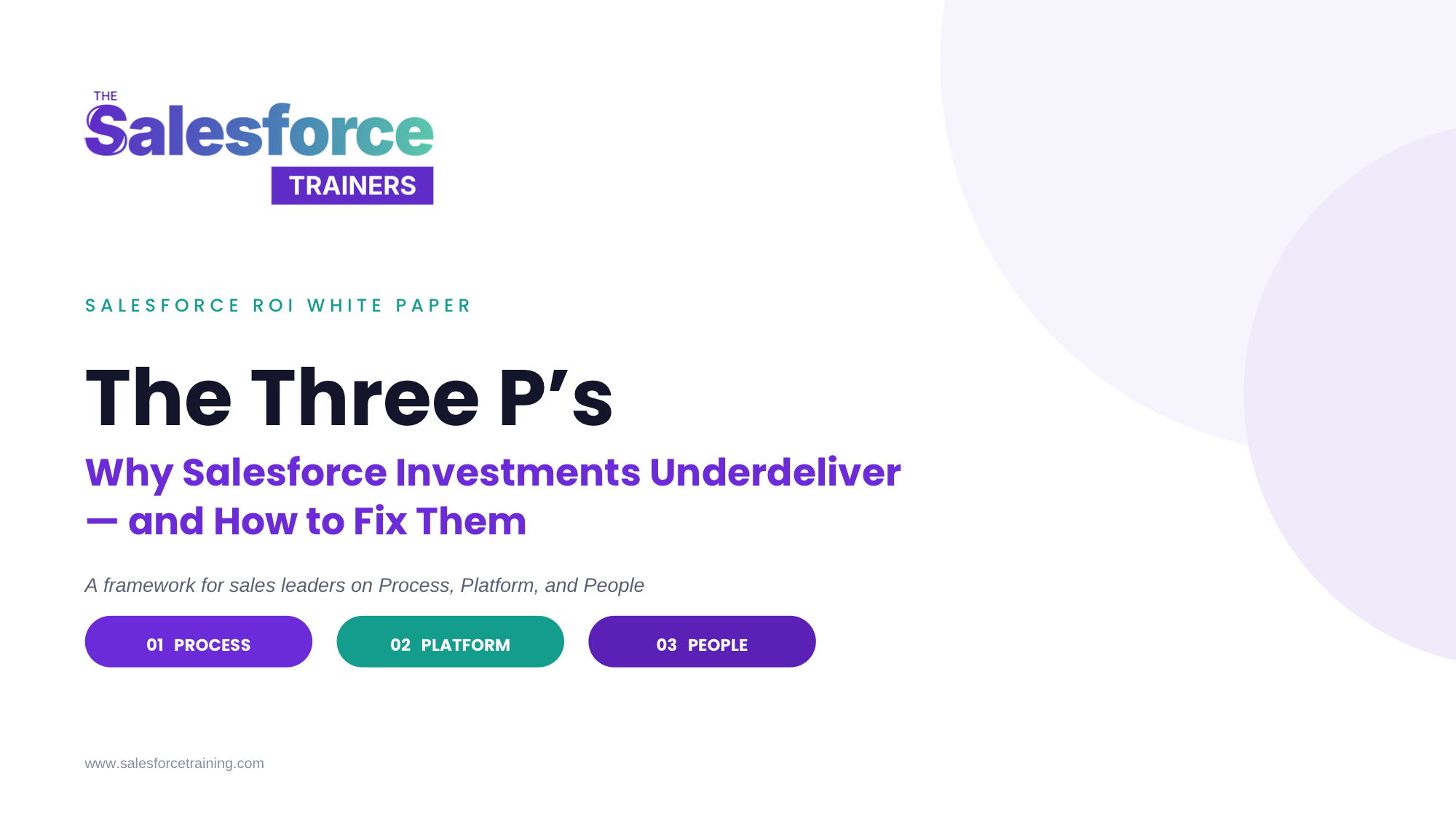
The Three P's — why Salesforce investments underdeliver.
The full framework in one practical read: the warning signs of misalignment across Process, Platform and People, and the questions to ask before your next Salesforce investment.
04 — Questions we get asked
P3 Framework FAQs.
What is the P3 Framework?
The P3 Framework is our model for getting real value from Salesforce by aligning three interconnected elements: Process (how your sales organization actually sells and is managed), Platform (how Salesforce is configured to support that), and People (how your team adopts new behaviors). Poor Salesforce ROI almost always traces back to a gap in one or more of the three — and technology alone cannot close them.
Why do so many Salesforce implementations fail?
Salesforce is a powerful platform, but technology alone doesn't guarantee success. Organizations struggle when sales processes are unclear, the platform becomes difficult to use, and change management is treated as an afterthought. The real issue isn't the technology—it's the lack of alignment between Process, Platform, and People.
What's the first step in the P3 Framework?
Salesforce should reinforce an effective sales process — not attempt to create one. If your methodology, stages, pipeline reviews and forecasting are undefined, configuring a CRM on top simply automates the confusion. Worse, many sales managers have never been formally trained to lead a modern sales organization, and without strong sales leadership even a flawless implementation struggles.
Why do sales teams stop using Salesforce?
Many Salesforce environments have become overly customized, difficult to navigate and underutilized — so reps avoid them. We audit configuration, user experience, automation, reporting, dashboards, data quality and security, then simplify wherever we can. The goal is to make Salesforce easier for salespeople to use while still giving management the visibility they need.
What is ADKAR, and why do you use it?
ADKAR is a change management model from Prosci — Awareness, Desire, Knowledge, Ability and Reinforcement. As certified change management practitioners, we build it into every engagement, because technology projects fail when people never adopt new behaviors. ADKAR ensures employees are ready, willing and able to work in a genuinely new way.
How would you apply the P3 Framework to our organization?
Every engagement begins with a comprehensive discovery assessment that evaluates your current state across all three pillars and delivers executive recommendations. Those findings become the foundation for ProSell™, our structured transformation program that aligns Process, Platform, and People to drive lasting Salesforce adoption and improved sales performance.
Do I need all three pillars, or can I fix just one?
The three are interconnected, which is why fixing one in isolation usually disappoints. A better process still stalls if the platform is unusable. A beautifully simplified platform still fails if nobody changes their habits. That said, every engagement starts with an assessment — if one pillar is clearly the bottleneck, we say so, and we start there.
Is this only for companies already using Salesforce?
Most of our clients have already invested heavily in Salesforce and are frustrated by what they are getting back. But the framework applies just as well before a rollout — defining the process and preparing your people up front is far less costly — in terms of time, energy and money — than retrofitting adoption after a disappointing launch.
Does this solution work for companies that use other CRMs, and not Salesforce?
Yes. Our expertise is focused exclusively on Salesforce because that's the platform our team has spent their careers implementing, optimizing, and supporting. Many of the challenges organizations experience—unclear sales processes, poor adoption, ineffective change management, and inconsistent sales leadership—exist regardless of the CRM they use. However, our approach is built around aligning Process, Platform, and People. Without the ability to optimize all three pillars, we can't deliver the outcomes our clients expect. We also believe Salesforce is one of the most powerful CRM platforms available. The challenges organizations experience rarely stem from the technology itself—they result from how Salesforce is implemented, configured, and adopted. When those three pillars are aligned, Salesforce becomes a catalyst for growth rather than another system people are expected to update.
Client results
Mark's clear and engaging presentation helped me better understand the platform's features, particularly how to effectively manage sales opportunities and track progress… I feel more confident using Salesforce to drive our team's success.
Mark's the man! He's the guy you want to bring in to train your Salesforce technical and business users. Very engaging, and presents lots of analogies that help learn abstract concepts.
Bill was extremely knowledgeable not only on the Salesforce side but also on Canon Medical's customized version of Salesforce modules. He did his homework very well. He kept the audience engaged throughout the session. Good work Bill!
Trusted by sales teams at






Which of the three is holding you back?
Every engagement begins with a discovery conversation. No pitch — just an honest look at your process, platform, and people.
Book a Discovery Call