Is Your Salesforce Ready for AI? Here’s How to Tell.
Everyone is talking about what AI is going to do with Salesforce.
Salesforce is putting AI agents into the platform. Anthropic and Salesforce have introduced Claudeforce. AI can already analyze pipeline, assess deal health, summarize accounts, prepare salespeople for meetings and help managers make better decisions.
It’s exciting stuff.
But there’s a question I think sales leaders should be asking before they jump in:
Is your Salesforce actually ready for AI?
Because here’s the uncomfortable truth: AI doesn’t fix a broken sales system. It amplifies it.
If your sales process is inconsistent, your Salesforce configuration is overly complicated, your data is unreliable and your people aren't using the system properly, giving AI access to Salesforce isn't going to magically solve those problems.
It may actually make them worse.
So how do you know if you're ready?
1. Is your sales process actually defined?
This sounds obvious, but you'd be surprised how many organizations have invested heavily in Salesforce without ever clearly defining how they sell.
Do your sales stages actually mean something? Do you have clear stage gates? Does everyone understand what has to happen before an Opportunity moves from one stage to the next? Do managers have a consistent approach to pipeline reviews, forecasting and coaching?
And perhaps most importantly, do you know what information needs to be captured at each stage to make a good sales decision?
If the answer to those questions is "sort of," you're not ready for AI yet.
AI needs a sales process to work within. It needs to understand what you're trying to accomplish, what constitutes a healthy deal, what information matters and what should happen next.
You can't automate a process you haven't defined.
2. Is Salesforce configured around the way you actually sell?
Salesforce is incredibly flexible.
That's both its greatest strength and, sometimes, its greatest weakness.
You can configure Salesforce to support just about any sales process. You can also configure it into something so complicated that your salespeople need a map to figure out what they're supposed to do.
Too many fields. Too many clicks. Confusing page layouts. Picklists nobody understands. Automations layered on top of other automations.
I've seen all of it.
Your Salesforce platform should make it easier for your people to follow your sales process—not force them to work around it.
That's even more important when AI gets involved.
If an AI agent is going to analyze your Opportunities, recommend actions or help a manager assess pipeline health, the underlying Salesforce architecture needs to make sense.
The AI may be intelligent. Your Salesforce still needs to be well designed.
3. Can you trust your Salesforce data?
This one is going to become enormous.
Today, a sales manager might look at a pipeline report and think, "I know half of this isn't real."
That's frustrating.
When AI is making recommendations based on that same pipeline, it's a much bigger problem.
Are your Opportunities being created consistently? Are close dates meaningful? Are next steps current? Are sales stages accurate? Are key fields completed? Are old Opportunities sitting in the pipeline because nobody wants to close them out?
If the answers aren't good, your AI isn't going to somehow know which data is trustworthy.
It will work with what you've given it.
Garbage in, garbage out.
The difference is that now the garbage can be analyzed, summarized and acted upon at machine speed.
That's not a reason to avoid AI.
It's a reason to fix your data.
4. Are your managers actually using Salesforce to manage?
This is one of the biggest indicators of Salesforce maturity I've seen.
Ask yourself:
Does my sales manager use Salesforce during pipeline reviews? Does the manager coach from the information in Salesforce? Does Salesforce help determine which Opportunities need attention? Is the forecast built from Salesforce, or does somebody maintain a separate spreadsheet because "Salesforce isn't accurate"?
If Salesforce isn't part of the way your managers manage today, an AI agent isn't going to magically change that.
In fact, I think the role of the sales manager becomes more important, not less important, as AI becomes more capable.
AI might tell a manager that an Opportunity looks unhealthy.
The manager still has to ask why.
AI might identify a deal that has stalled.
The manager still has to coach the salesperson.
AI might identify a pipeline risk.
The manager still has to decide what action to take.
Technology can surface the signal.
Sales leaders still have to lead.
5. Are your people ready?
There's another uncomfortable question.
Do your salespeople actually know how to use Salesforce?
Not "Did they attend Salesforce training six months ago?"
I mean: Do they understand how Salesforce fits into the way they sell?
Do they know what good Opportunity management looks like? Do they understand why certain information is required? Do they believe Salesforce helps them sell—or do they see it as another system their manager makes them update?
And are your managers reinforcing the behavior?
Training gives people knowledge.
It doesn't automatically create behavior.
That's why Salesforce adoption has always been about more than training. People need to understand the process, the technology needs to support it, and managers need to reinforce it.
AI doesn't change that equation.
It makes it more important.
So, are you ready for AI?
Here's a simple test.
Look at your Salesforce today and ask yourself:
If I gave an AI agent access to my Salesforce right now, would I trust what it told me about my pipeline?
Would you trust its assessment of deal health?
Would you trust its recommendations about which Opportunities need attention?
Would you trust it to identify the risks in your forecast?
Would you trust it to tell your sales managers where they should focus their coaching?
If the answer is yes, you're probably in pretty good shape.
If the answer is "Well, not really...", that's useful information.
It tells you where to start.
This is where Process, Platform and People matter
I've been talking about Process, Platform and People for years because all three have to work together if you want Salesforce to deliver value.
AI doesn't change that.
It reinforces it.
Process
Have you defined how you sell? Do your stages mean something? Do you have clear stage gates? Do your managers have a consistent approach to pipeline reviews and coaching? Do you know what information is required to make a good sales decision?
If not, start there.
Platform
Does Salesforce actually support your sales process? Is the system simple enough for your salespeople to use? Is the architecture logical? Are the right fields available without overwhelming people? Are your automations and workflows helping rather than getting in the way?
If not, fix the platform.
People
Do your salespeople and managers know how to use Salesforce effectively? Do they understand why it matters? Are they using it as part of their normal sales and management routines? Are managers reinforcing the behaviors you need?
If not, address the people side.
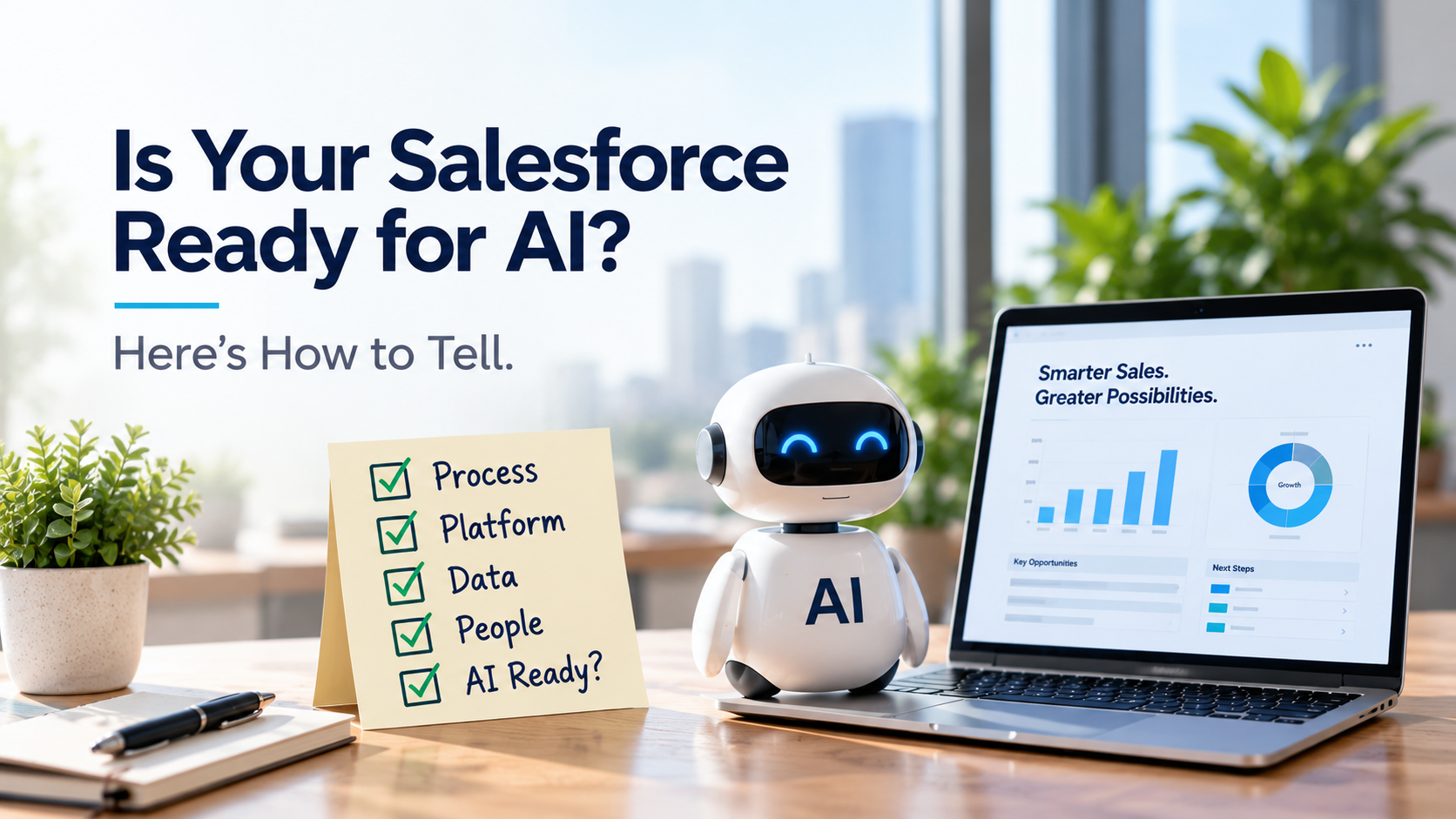
That's your AI readiness checklist.
AI readiness isn't an AI project
This is the part I think many organizations are going to get wrong.
They'll hear about the latest AI capability and immediately start asking:
How do we turn it on?
I think the better question is:
Are we ready to use it?
There's a big difference.
Getting your Salesforce organization ready for AI isn't primarily about buying another technology.
It's about making sure your sales process is defined, your Salesforce platform is optimized, your data is trustworthy and your people are prepared.
Once those pieces are in place, AI becomes incredibly interesting.
Because now you're not asking AI to make sense of a messy sales organization.
You're giving it a well-designed sales system to work with.
And that's when things get really exciting.
Salesforce isn't going away. AI isn't going away. And the organizations that prepare properly now are going to have a significant advantage over those that simply turn on the latest AI feature and hope for the best.
AI is only as good as the sales system you give it.
That's why getting your Salesforce ready for AI should start before you deploy the AI—not after.