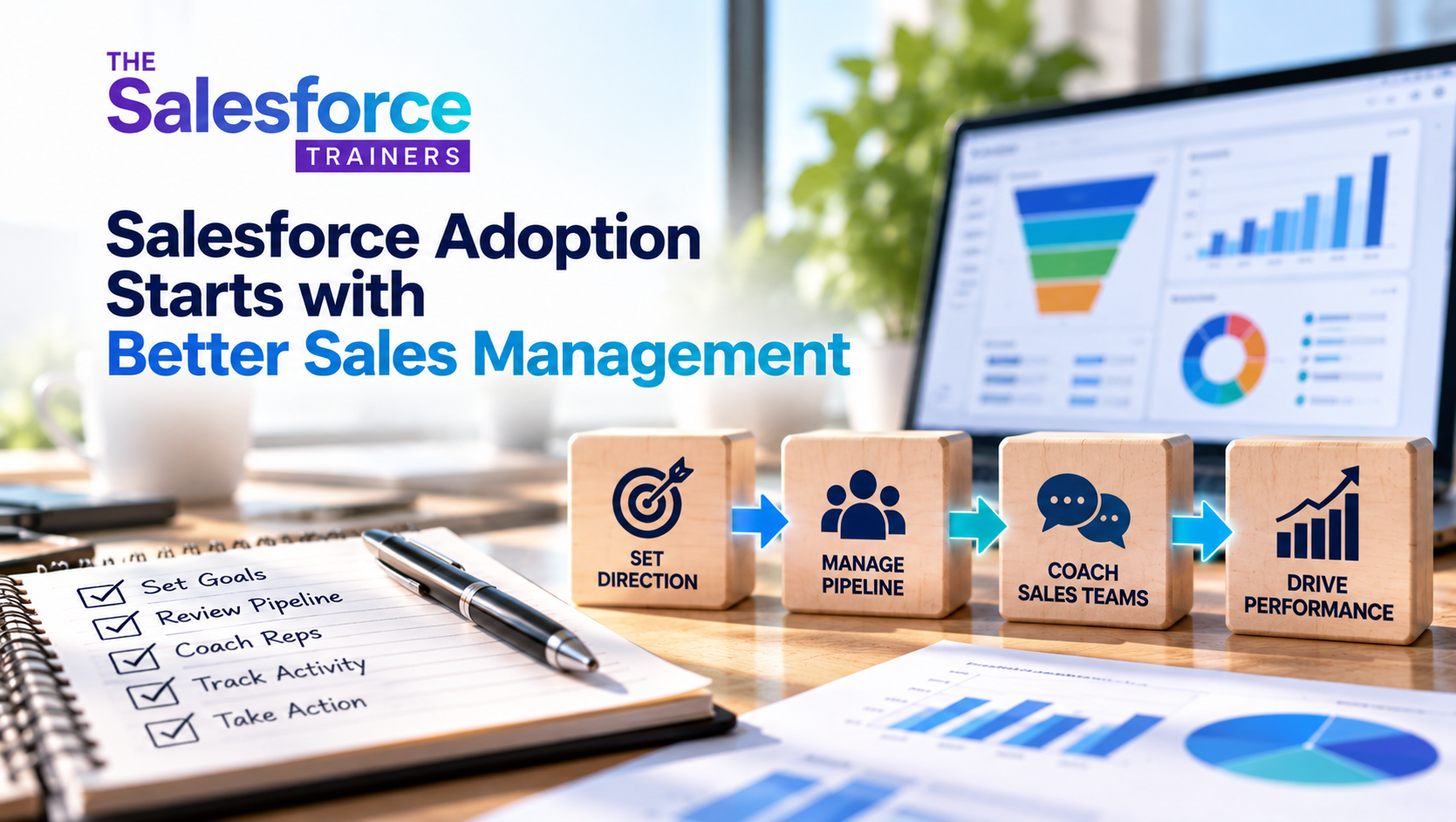
Salesforce Adoption Starts with Better Sales Management
Salesforce adoption is a common challenge for sales organizations. Companies invest significant time and money implementing Salesforce, customizing the platform, providing training and rolling out new processes. Yet months or even years later, they're still struggling to get their sales teams to use it consistently.
The usual response? More training. More reminders. More reporting. More pressure on salespeople to update their opportunities and enter their activities.
But what if we're solving the wrong problem?
Adoption should be the byproduct, not the objective.
The real objective should be getting sales managers to use Salesforce to manage the business.
And here's something I've observed working with numerous sales organizations: many companies struggling with Salesforce adoption haven't established a consistent sales management practice in the first place.
They have no formal sales management playbook. No clearly defined guidelines for conducting pipeline reviews. No consistent coaching process. And often, very little understanding of which leading indicators actually predict future sales performance.
In some cases, there is barely a defined management process to support, whether Salesforce is involved or not.
So why are we surprised when Salesforce adoption becomes a struggle?
You can't expect a technology platform to create management discipline that doesn't already exist.
The Adoption Trap: Measuring Usage Instead of Management Effectiveness
Let's look at what typically happens when an organization struggles with Salesforce adoption.
Leadership wants better pipeline visibility, more accurate forecasting, improved sales productivity and stronger accountability.
But when those outcomes don't materialize, attention shifts toward the users.
Why aren't our reps updating Salesforce? Why is our pipeline data incomplete? Why do opportunities sit in the same stage for weeks? Why are managers still asking for spreadsheets? Why aren't people following the process?
These are legitimate questions. But they tend to produce solutions focused on compliance rather than performance.
Organizations introduce additional training, stricter data-entry requirements, adoption dashboards and reminders to update records.
The problem is that these measures focus on whether people are using Salesforce, not whether Salesforce is helping them do their jobs better.
A salesperson who updates an opportunity because their manager told them to is using Salesforce. But that doesn't necessarily mean the organization is managing its sales operation effectively.
A sales manager who uses Salesforce to identify stalled deals, challenge pipeline assumptions, coach individual reps and take corrective action is doing something fundamentally different.
They're using Salesforce to manage the business.
That distinction matters because the second behavior creates a reason for the first.
If Salesforce becomes essential to how managers lead, inspect and improve performance, salespeople have a much stronger reason to maintain accurate and timely information.
Instead of constantly pushing adoption from the bottom up, organizations can create the management practices that make consistent usage necessary and valuable.
For a deeper look at the underlying causes, read our article on why Salesforce adoption fails and how to fix it.
The Bigger Problem: You Can't Improve What You Haven't Defined
Consider a sales organization with ten sales managers.
Each manager conducts pipeline reviews differently. One focuses on the total value of the pipeline. Another concentrates on deals expected to close this month. A third reviews opportunities only when a forecast is due. Several managers rely on their own spreadsheets, and some don't conduct structured pipeline reviews at all.
There is no common definition of a healthy pipeline. No consistent criteria for moving opportunities between stages. No agreed-upon coaching expectations. And no standard approach to identifying emerging risks.
Now introduce Salesforce.
The organization configures dashboards, builds reports and provides training. Everyone is shown how to update opportunities, run reports and maintain the system.
But what exactly are managers expected to do with all this information?
Without a common management framework, each manager continues to operate according to personal preference. The dashboards may be available, but there is no consistent practice requiring managers to use them. The reports may contain useful data, but nobody has agreed on what to look for or what action to take.
The organization has implemented a CRM without establishing the management discipline needed to make it valuable.
And the problem goes deeper than pipeline reviews.
Many organizations measure lagging indicators such as revenue, quota attainment and closed deals, but pay little attention to the leading indicators that help managers anticipate future results.
How many qualified opportunities are entering the pipeline? How effectively are opportunities progressing? How long are deals remaining in each stage? How frequently are meaningful customer conversations taking place? Are reps developing sufficient pipeline to support future targets?
These are the kinds of questions that help managers move from reporting on results to actively managing performance.
Without defined indicators, consistent management practices and clear expectations, Salesforce is simply a repository of information.
The technology can't compensate for the absence of a management system.
The Research: Effective Sales Coaching Is More Than a Management Activity
There's good evidence that effective sales management behaviors matter.
A study published in Personnel Psychology examined 1,246 sales representatives across 136 teams within a pharmaceutical organization over a year.
The researchers found that managers' coaching skill was directly related to the annual sales goal attainment of the representatives they supervised. Coaching skill also helped clarify employees' roles and influenced the relationship between coaching frequency and goal attainment.
One particularly important finding deserves attention: coaching frequency had a negative relationship with goal attainment when coaching skill was low.
In other words, simply coaching more often isn't necessarily better.
The quality of coaching matters.
This has an important implication for organizations trying to improve Salesforce adoption.
Providing managers with dashboards, reports and activity data is only part of the solution. Managers also need the skills and processes to interpret that information, ask the right questions, provide useful feedback and help their people improve.
Salesforce can make relevant information available. It cannot automatically turn that information into effective coaching.
Another study, published in the International Journal of Productivity and Performance Management in 2022, examined managerial coaching and sales performance. Based on 167 survey responses, the researchers found that managerial coaching positively influenced salesforce performance through customer orientation and results orientation.
Together, these studies reinforce an important point: sales management is not simply about inspecting numbers or increasing the frequency of conversations. It's about using structured management practices to influence behavior and improve performance.
Salesforce should support those practices.
It shouldn't be expected to replace them.
Research sources
Does Coaching Matter? A Multilevel Model Linking Managerial Coaching Skill and Frequency to Sales Goal Attainment, Personnel Psychology, 2016.
Managerial Coaching and Sales Performance: The Influence of Salesforce Approaches and Organisational Demands, International Journal of Productivity and Performance Management, 2022.
The 2.4× Finding: Organizational Alignment Matters
Salesforce Research has also identified a meaningful relationship between organizational alignment and sales performance.
In its State of Sales research, Salesforce found that high-performing sales teams were 2.4 times more likely than underperforming teams to report that their organizations were aligned around how to empower salespeople to exceed their goals.
The report found that 87% of high-performing teams reported this alignment, compared with 35% of underperforming teams.
This was a finding about organizational alignment, not CRM adoption or sales management effectiveness specifically. The research is from an older edition of the report, so it should be understood in its original context rather than treated as a current benchmark.
Nevertheless, it supports a principle central to effective sales management.
People perform better when the organization is aligned around how to help them succeed.
That alignment requires more than a sales target and a CRM login. It requires clear expectations, consistent management practices, appropriate tools and leadership that reinforces the behaviors needed to achieve results.
Sales managers are the critical link between organizational expectations and the daily activities of the sales team.
When those managers are equipped to lead effectively, Salesforce can become an important part of how that alignment is put into practice.
What Should Sales Managers Actually Be Doing in Salesforce?
If adoption isn't the primary objective, what should organizations focus on instead?
Start by defining the management practices that drive performance.
Here are five areas where Salesforce can become an indispensable management tool.
1. Establish a Consistent Pipeline Management Process
Pipeline management should be more than reviewing the total dollar value of open opportunities.
Managers need a consistent approach to assessing opportunity quality, deal progression, risk and the likelihood of closing.
That means defining what a healthy opportunity looks like, establishing meaningful stage-exit criteria and agreeing on how stalled deals, missing information and unrealistic close dates will be addressed.
Salesforce should be configured to support these practices, giving managers the information they need to conduct structured, productive pipeline reviews.
The important distinction is that the management process comes first. Salesforce reinforces the process; it doesn't invent one.
If your organization needs help defining or improving that process, our Sales Process Consulting can help establish the management practices Salesforce should support.
2. Define and Track Meaningful Leading Indicators
Revenue, quota attainment and closed deals tell you what has already happened.
Leading indicators help managers understand what may happen next.
Depending on the sales model, relevant indicators might include:
- Qualified opportunities created
- Pipeline coverage relative to targets
- Opportunity progression and stage conversion
- Average time spent in each sales stage
- Percentage of opportunities with a defined next step
- Meaningful customer engagement
- Pipeline generation by individual rep or team
Not every organization needs every metric. The goal is to identify a small set of indicators that are genuinely predictive of performance in that business.
Once those indicators are defined, Salesforce Platform Optimization can provide the reports, dashboards and visibility managers need to act on them.
Managers can then use the information to identify gaps, coach individuals and take action before missed targets become inevitable.
That's a much more valuable use of Salesforce than simply monitoring whether records have been updated.
3. Make Salesforce Central to Coaching Conversations
One-on-one meetings should be opportunities to improve performance, not administrative status updates.
Managers should use Salesforce to prepare for coaching conversations, identify patterns and focus on the specific challenges each rep faces.
For example, a manager might notice that a rep creates plenty of opportunities but struggles to move them beyond the initial stages.
Rather than simply asking for more activity, the manager can explore qualification skills, customer engagement, decision-maker access and the effectiveness of the rep's sales approach.
Another rep may consistently advance opportunities but struggle to close them. That calls for a different coaching conversation.
Salesforce can help managers recognize these patterns and direct their coaching toward the behaviors most likely to make a difference.
But managers need a consistent coaching framework and the skills to use it effectively.
A dashboard doesn't coach a salesperson. A capable manager does.
4. Establish a Consistent Sales Management Rhythm
Effective management requires consistency.
Sales organizations should establish an operating rhythm that defines when and how managers review performance, assess pipeline health, coach individuals and make decisions.
For example:
- Weekly: Conduct structured pipeline reviews and identify opportunities requiring intervention.
- Biweekly: Hold individual coaching conversations focused on performance, development and deal strategy.
- Monthly: Review leading indicators, conversion trends, forecast accuracy and individual performance.
- Quarterly: Assess overall sales effectiveness, identify systemic performance gaps and adjust priorities.
The exact cadence should reflect the sales cycle, team size and business model.
The key is that Salesforce becomes part of these routines.
Managers should enter pipeline reviews prepared with Salesforce information. Coaching conversations should draw on relevant performance data. Forecast discussions should use agreed-upon definitions and reliable information.
When Salesforce is embedded into the management rhythm, consistent usage becomes part of the way the business operates.
5. Hold Managers Accountable for Management Effectiveness
If organizations want meaningful Salesforce adoption, they need to measure more than user activity.
Login frequency, record updates and field completion can help identify potential adoption issues, but they don't reveal whether managers are leading effectively.
Consider measuring management practices such as:
- Consistency and quality of pipeline reviews
- Use of defined opportunity criteria
- Frequency and quality of coaching conversations
- Identification and resolution of pipeline risks
- Review of agreed leading indicators
- Forecasting discipline and accuracy
- Follow-through on management actions
These measures should be used to support better management, not create another layer of administrative compliance.
The objective is to establish clear expectations, provide managers with the capabilities to meet them and reinforce behaviors that contribute to business performance.
When managers are accountable for how they manage the business, Salesforce becomes an important tool for delivering on those expectations.
From Adoption Initiatives to a Sales Management Playbook
This is where many organizations need to start.
Before introducing another Salesforce adoption initiative, take a step back and ask whether you have clearly defined what effective sales management looks like.
Do your managers have a common playbook?
Do they know how to conduct a productive pipeline review?
Have you established meaningful leading indicators?
Are coaching expectations consistent across teams?
Do managers understand how to use Salesforce to identify performance gaps and take action?
Can leadership explain what good sales management looks like in practical, observable terms?
If the answers are unclear, the priority may not be another round of Salesforce training or another dashboard.
It may be time to build the management framework that Salesforce should support.
That doesn't necessarily require an elaborate process or a lengthy consulting engagement. Often, the biggest improvement comes from agreeing on a handful of essential practices, defining clear expectations and equipping managers to execute them consistently.
Once those practices are established, Salesforce can be configured and used to reinforce them.
That's the foundation for sustainable change.
The P3 Framework: Process First. Platform Second. People Throughout.
At The Salesforce Trainers, we approach these challenges through our Process, Platform and People (P3) Framework.
It's based on a simple principle: Salesforce delivers value when the way the business operates, the technology supporting it and the people responsible for execution are aligned.
Process: Define the sales management playbook, sales methodology, opportunity stages, pipeline review practices, forecasting discipline, coaching expectations and leading indicators.
Platform: Configure Salesforce to support those processes. Give managers the reports, dashboards, workflows and visibility they need to run the business effectively, while minimizing unnecessary complexity for salespeople.
People: Equip sales managers and their teams with the skills, knowledge and behaviors required to make the process and technology work. Reinforce the new practices through leadership, coaching, training and change management.
The sequence matters.
Configuring Salesforce on top of an undefined sales process simply automates inconsistency.
Providing training without a clear management framework gives people knowledge without a consistent reason to apply it.
And establishing a strong process without equipping managers to lead it makes sustainable execution difficult.
Our P3 Framework explains how these elements work together to improve Salesforce effectiveness.
The goal is not to maximize usage for its own sake. It's to create a sales organization where Salesforce supports better management, stronger execution and more informed decisions.
Stop Chasing Adoption. Start Managing the Business.
If Salesforce adoption is still a struggle in your organization, consider a different question.
Instead of asking how to get more salespeople to use Salesforce, ask whether your sales managers have a consistent, effective way to manage the business.
Do they have a playbook?
Are they conducting structured pipeline reviews?
Do they track the leading indicators that help predict performance?
Are they using Salesforce to coach their teams, identify risks and make decisions?
If not, you may have found the real source of your adoption problem.
Salespeople take their cues from their managers. When managers consistently use Salesforce to lead, coach and manage performance, they create a compelling reason for their teams to maintain accurate and timely information.
The platform becomes relevant to the work that matters.
Make Salesforce indispensable to your sales managers, and adoption follows.
That's a much more meaningful objective than simply increasing the number of users who log in.
And it's a far better foundation for turning your Salesforce investment into measurable business value.
Is Your Sales Management Process Working?
If you're struggling with Salesforce adoption, let's start by examining how your sales managers actually run the business.
The Salesforce Trainers can offer a focused Sales Management and Pipeline Review Assessment to help you evaluate your current practices, identify gaps in your pipeline review process, examine your use of leading indicators and determine how effectively Salesforce supports your managers.
A focused diagnostic conversation can explore questions such as:
- Do your managers follow a consistent pipeline review process?
- Are opportunity stages and qualification criteria clearly defined?
- Are managers using meaningful leading indicators to identify risks and coach performance?
- How effectively are managers using Salesforce during pipeline reviews and one-on-one conversations?
- What management practices, reporting improvements or training would make the biggest difference?
The initial conversation is designed to identify potential gaps and priorities. If a more detailed assessment is warranted, we can discuss the appropriate scope and deliverables.
Rather than immediately recommending more technology or another adoption campaign, we'll focus on the management practices that should drive the value of your Salesforce investment.
Ready to take a closer look at how your sales managers run the business?
Contact The Salesforce Trainers to discuss a Sales Management and Pipeline Review Assessment.
Let's stop chasing adoption and start building a sales organization that knows how to manage effectively.