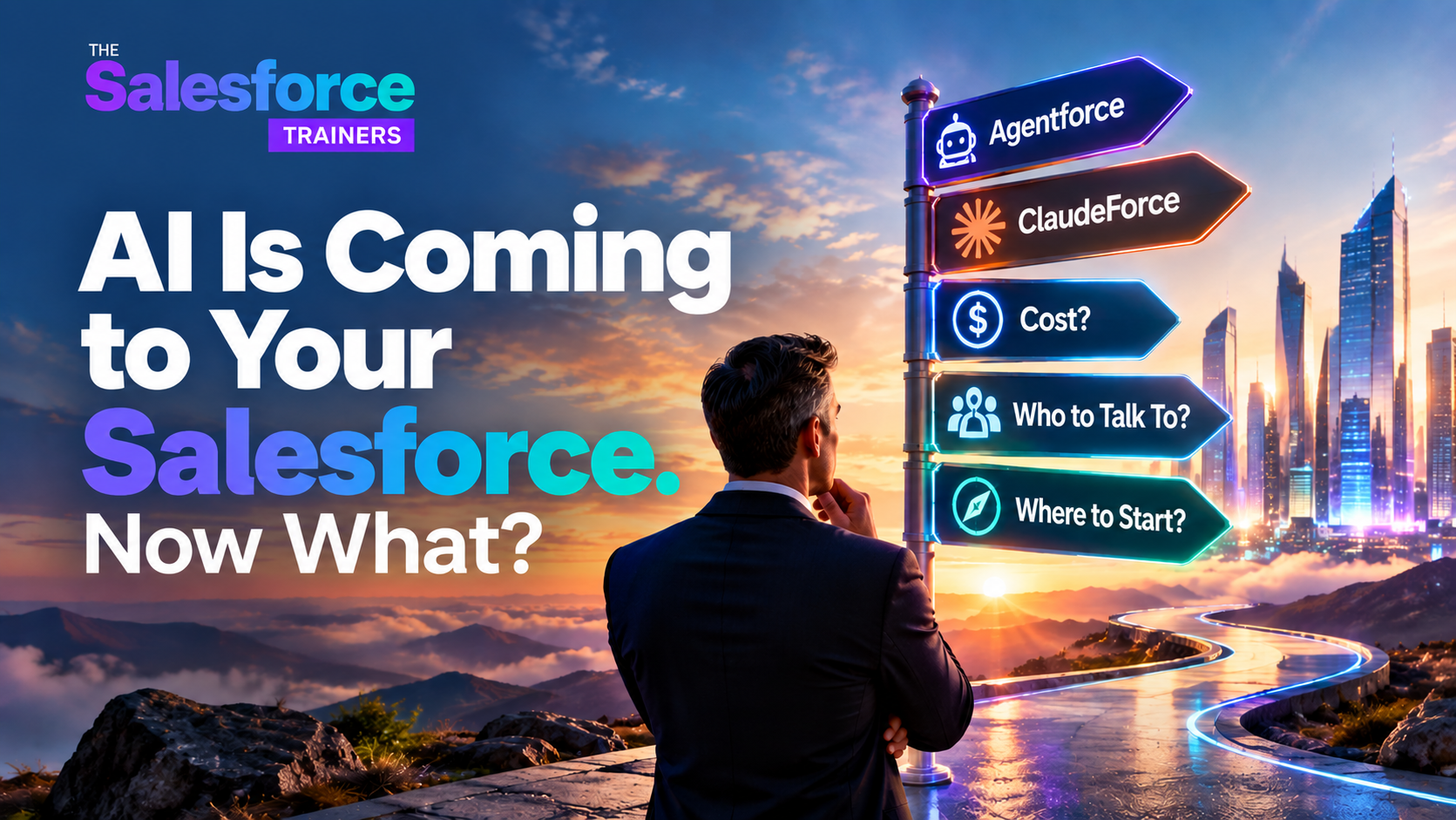
AI Is Coming to Your Salesforce. Now What?
If you're a sales leader, you've probably noticed that AI is suddenly everywhere.
You're hearing about AI in Salesforce.
You're hearing about Agentforce.
You're hearing about Claudeforce.
You're hearing about AI agents that can research accounts, summarize opportunities, prepare for meetings, update Salesforce, analyze pipeline and even take action on behalf of your salespeople.
And if you're paying attention, you're probably thinking:
Okay. This is clearly going to matter to my sales organization. But where do I even start?
That's a reasonable question.
The pace of change is extraordinary. Salesforce is expanding Agentforce, Salesforce and Anthropic have launched Claudeforce, and Salesforce is now talking about AI operating across the data, workflows, business logic, permissions and governance already inside your CRM. (Salesforce)
So if you're a VP of Sales, CRO, Sales Operations leader or sales manager trying to figure all of this out, here's my advice:
Don't start by buying AI.
Start by figuring out what you actually want AI to do for your sales organization.
First, Understand What All This AI Actually Means
Part of the confusion is that we're using the word AI to describe a lot of very different things.
There's generative AI that can write an email or summarize a meeting.
There's predictive AI that can identify patterns and make recommendations.
And then there's agentic AI — systems that can reason through a task, use tools, interact with business systems and take action.
That's where Salesforce is putting a lot of its attention with Agentforce.
Salesforce describes Agentforce as AI agents that can perform work across the business, and its current portfolio includes agents for sales, service and other functions. (Salesforce)
Then there's Claudeforce.
Salesforce and Anthropic announced Claudeforce in August 2026, combining Claude's reasoning capabilities with Salesforce data, workflows, business logic, actions and governance. The initial Salesforce-in-Claude offering includes 37 prebuilt sales skills covering areas such as meeting preparation, deal health and pipeline review. (Salesforce)
So yes, there's a lot happening.
But you don't need to understand every new AI product that gets announced.
You need to understand what problems you want AI to solve.
Start With Your Salespeople, Not the Technology
Here's where I think sales leaders can get themselves into trouble.
You see a demonstration of an AI agent doing something incredibly impressive.
You think, We need that.
Maybe you do.
But before you start talking about technology, talk to your salespeople.
Ask them:
Where are you wasting the most time?
What information takes forever to find?
What administrative work gets in the way of selling?
What do you wish you knew before going into a customer meeting?
What takes you an hour that should take ten minutes?
Where do sales managers spend time gathering information instead of actually coaching?
Those answers will tell you much more about where AI could help than another product demonstration.
For example, if your sales managers spend hours every week preparing for pipeline reviews, an AI capability that can analyze opportunities and identify potential risks could be extremely useful.
If salespeople spend enormous amounts of time preparing for customer meetings, AI could potentially help assemble relevant account history, recent activity, opportunity information and other context.
Those are business problems.
The AI is simply one potential way to solve them.
Then Look at Your Salesforce Data
This is where things get interesting.
AI doesn't magically understand your business just because you've connected it to Salesforce.
It needs something to work with.
If your Opportunity stages aren't meaningful, your close dates aren't trustworthy, your next steps are missing and your salespeople don't consistently update their records, an AI system is going to be working with questionable information.
And that's important because the more sophisticated AI becomes, the more important the underlying Salesforce environment becomes.
Salesforce itself is increasingly emphasizing this idea. Its current AIforce strategy is built around making Salesforce's data, workflows, business logic, semantics, permissions, security and governance available to AI interfaces and agents. (Salesforce)
Think about that for a minute.
AI isn't just going to need your data.
It's going to need to understand how your business works.
That's a very different proposition.
This Is Where Process, Platform and People Matter
This is exactly why we've built our business around Process, Platform and People.
Process
Before AI can intelligently operate within your sales organization, your sales process needs to be defined.
What constitutes a qualified opportunity?
What does each stage mean?
What information should be available at each stage?
What does a healthy deal look like?
What should happen next?
If every salesperson and sales manager has a different answer, you're going to have a hard time getting AI to give you a consistently useful answer.
Platform
Your Salesforce platform needs to support that process.
The data needs to be accessible.
The configuration needs to make sense.
The automation needs to work.
The information needs to be trustworthy.
And the system needs to reflect the way your sales organization actually operates.
People
And then there's the part that gets overlooked in all of the AI excitement:
People still have to use the system.
Your salespeople need to trust the information.
Your managers need to use Salesforce to manage the business.
Your leaders need to reinforce the expected behaviours.
And everyone needs to understand how AI fits into the way they work.
AI doesn't eliminate the people side of Salesforce.
It makes it more important.
So, What Is This Going to Cost?
This is probably the next question I would ask.
And unfortunately, there's no simple answer.
Salesforce's current Agentforce pricing illustrates why.
Salesforce offers consumption-based pricing through Flex Credits, pricing based on conversations, and various per-user licensing options. Its current Canadian pricing page lists Flex Credits at US$500 per 100,000 credits and Agentforce for Sales at US$125 per user per month, while other Agentforce editions and licensing models have different pricing structures. (Salesforce)
And those prices can change.
More importantly, the software cost is only one part of the equation.
You also need to think about:
What are you actually trying to accomplish?
How many people will use it?
What data will the AI need?
What Salesforce configuration changes are required?
What integrations are involved?
What governance and security requirements do you have?
Who will build and maintain the solution?
How will you train and support your users?
How will you measure whether it's actually producing value?
That's why I wouldn't start your AI conversation with:
“How much does Agentforce cost?”
I'd start with:
“What problem are we trying to solve?”
Then determine what technology is appropriate.
Should You Talk to Salesforce?
Absolutely.
If you're already a Salesforce customer, your Salesforce Account Executive should be part of the conversation.
Salesforce knows its products. They can explain what's available, what's included in your current licensing, what additional products or capacity you may need, and what their roadmap looks like.
You should understand what Salesforce is offering you.
But I wouldn't necessarily make Salesforce the only conversation you have.
Why?
Because Salesforce has a natural interest in helping you adopt Salesforce products.
That's not a criticism. It's simply how vendors work.
If you're trying to determine what your sales organization actually needs, you may also want an independent perspective from someone who understands sales process, Salesforce configuration and adoption.
That's a different conversation.
Who Should You Talk To?
I'd suggest thinking about this in three conversations.
1. Talk to Salesforce
Find out what's already available to you.
Ask what AI capabilities are included in your current Salesforce environment.
Ask what would require additional licensing.
Ask about Agentforce.
Ask about the capabilities coming down the road.
And most importantly, ask them to demonstrate your use cases, not just their technology.
2. Talk to Your Salesforce Admin or Sales Ops Team
Your internal team knows your Salesforce environment.
They know where the data problems are.
They know which integrations exist.
They know what has been customized.
They know where the technical debt is hiding.
That information is essential before you start giving AI more responsibility.
3. Talk to Someone Who Understands Sales and Adoption
This is the piece I think gets missed.
You don't just need someone who understands AI.
You need someone who understands how your sales organization actually works.
Because the question isn't:
“Can AI do this?”
The question is:
“Should AI do this, and will our salespeople actually use it?”
That's where an experienced Salesforce consultant or adoption partner can be valuable.
The technology conversation and the business conversation need to happen together.
Don't Let an AI Demo Drive Your Strategy
This is probably the biggest piece of advice I'd give any sales leader right now.
Don't fall in love with the demo.
AI demonstrations are impressive.
You can watch an agent research an account, analyze a pipeline, summarize a meeting and take action in seconds.
But your organization isn't a demo.
Your Salesforce environment is unique.
Your sales process is unique.
Your data is unique.
Your people are unique.
And your problems are unique.
The right question isn't:
“What can Agentforce do?”
Or:
“What can Claude do?”
Or:
“What can Salesforce's newest AI product do?”
The right question is:
“Where could AI create meaningful value for our sales organization?”
Then work backward from there.
Pick One Problem
You don't need an enterprise-wide AI strategy on day one.
Pick one problem.
Maybe it's pipeline hygiene.
Maybe it's meeting preparation.
Maybe it's opportunity inspection.
Maybe it's account research.
Maybe it's sales forecasting.
Maybe it's administrative work that your salespeople hate doing.
Define the problem.
Define what success looks like.
Make sure your Salesforce data can support it.
Then test it.
If it works, expand.
If it doesn't, you've learned something without spending six months trying to transform your entire sales organization.
And Don't Forget About Adoption
There's one more thing I'd be very careful about.
You can implement the most sophisticated AI technology in the world and still fail to get value from it if your salespeople don't use it.
We've seen this movie before.
It was called Salesforce adoption.
Organizations spent enormous amounts of money implementing Salesforce.
They built sophisticated platforms.
They trained their people.
And then wondered why salespeople weren't using the system consistently.
AI doesn't eliminate that problem.
It can actually make it more expensive.
If your Salesforce platform is poorly designed, your process isn't standardized and your people aren't aligned, adding AI isn't necessarily going to fix those problems.
In some cases, it may simply expose them faster.
That's why our approach to Salesforce adoption and change management starts with the fundamentals.
Get the process right.
Get the platform right.
Get the people aligned.
Then figure out where AI can make those things better.
You Don't Need to Become an AI Expert
And finally, don't feel like you need to understand every AI announcement coming out of Salesforce, Anthropic, Microsoft, OpenAI or anyone else.
You don't.
Your job as a sales leader isn't to become an AI engineer.
Your job is to understand where your sales organization can use technology to sell more effectively, manage better and make better decisions.
AI is going to change the way sales teams work.
That's already happening.
The question isn't whether you should pay attention.
You absolutely should.
The question is how you make sure you're investing in the right things.
So here's where I'd start:
Don't start with the AI.
Start with your sales process.
Identify where your salespeople and managers are wasting time.
Look at the quality of your Salesforce data.
Understand what your current Salesforce environment can already do.
Talk to Salesforce about what's available.
Get an independent perspective if you need help figuring out what actually makes sense for your organization.
And then pick one meaningful problem to solve.
Because AI is moving fast.
You don't have to.
You just need to make sure you're moving in the right direction.