Is Your Salesforce Ready to Be the AI Operating System?
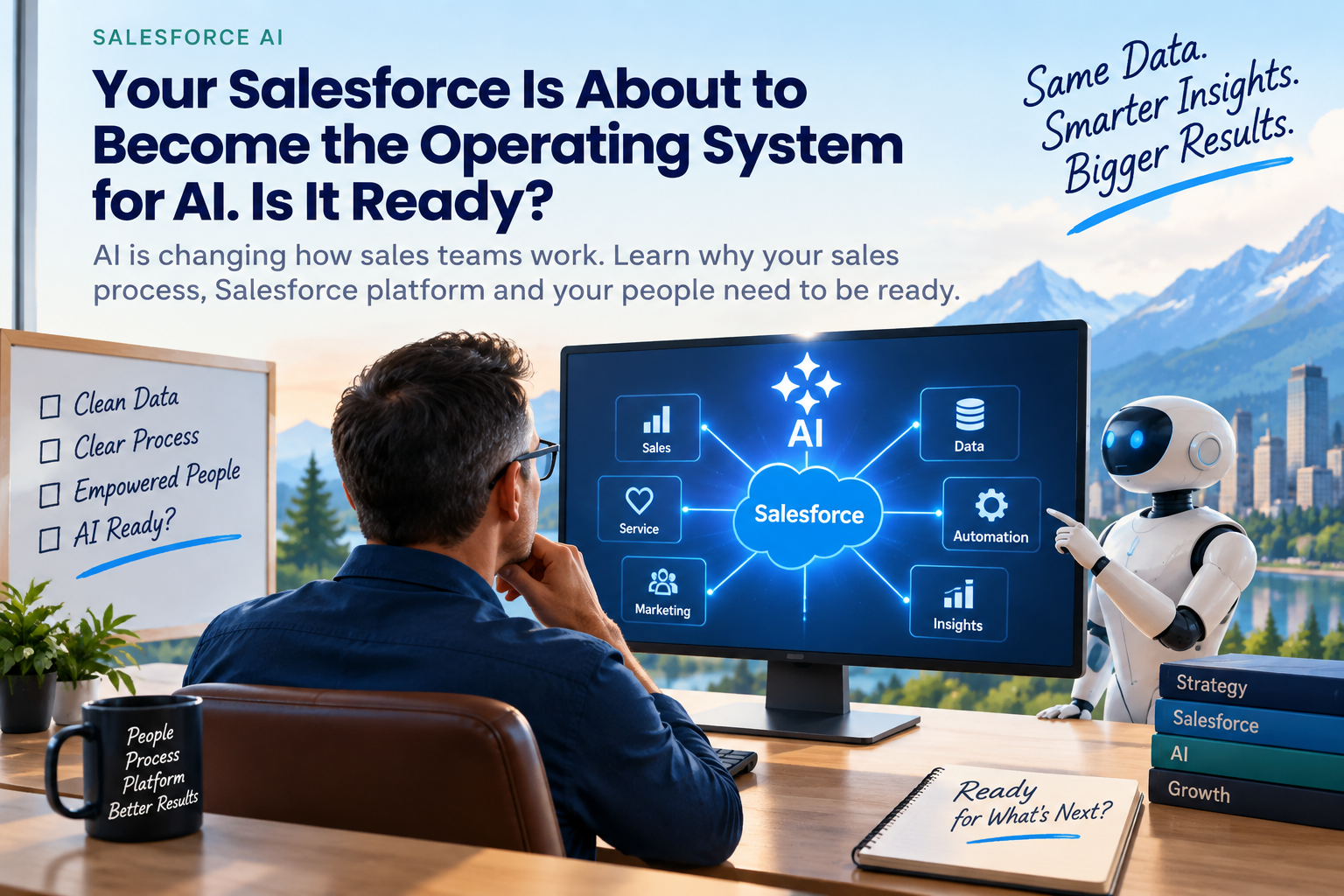
Salesforce just introduced what it calls the Trusted Enterprise AI Harness.
The name may sound like another piece of Salesforce terminology that you'll eventually have to learn, but I think what's underneath it is much more significant.
Salesforce is essentially building an architecture that allows AI agents to operate within an organization's business environment—with access to the right data, processes, workflows, permissions, security and governance.
In other words, Salesforce isn't simply making AI smarter.
It's giving AI a way to understand how your business works—and actually do things within it.
And that changes the conversation for sales leaders.
Because if you're going to give AI access to your sales organization, there's a much bigger question you need to answer first:
Is your Salesforce actually ready for AI?
AI Needs More Than Your Data
We've spent years talking about Salesforce as a CRM and a system of record.
Salespeople put information into Salesforce. Managers look at the pipeline. Leadership looks at forecasts and reports.
But Salesforce's vision for AI goes considerably further.
The AI Harness is designed to give agents access to trusted context, reasoning, actions, governance, security and the appropriate AI models. Salesforce calls this an AI Control Plane, giving organizations a way to manage and govern the growing number of AI agents operating across the business.
That's important because an AI agent doesn't just need access to your customer records.
It needs to understand what those records mean and what it's supposed to do with them.
Consider a question a sales manager might ask:
Which deals in my pipeline are most at risk of slipping this quarter, and what should I do about them?
That sounds like a straightforward AI question.
It isn't.
To answer it intelligently, AI needs to understand your sales stages, your definition of a qualified Opportunity, what constitutes a healthy deal, what information should be captured at each stage, your sales methodology, your forecasting process and potentially what actions a manager is authorized to take.
AI doesn't just need your data. It needs to understand how your business works.
And that's where things get interesting.
Salesforce Can't Define Your Sales Process for You
This is the part that I think sales leaders need to pay particular attention to.
Salesforce can provide the platform.
It can provide the data architecture, workflows, automation, security, governance and AI capabilities.
But it can't decide what your sales process should be.
You still have to answer the fundamental questions.
What does a qualified Opportunity mean? What does each sales stage actually represent? What information should be captured before an Opportunity moves forward? What constitutes a healthy pipeline? What should a manager do when a deal stalls? What actions should an AI agent be allowed to take?
Those aren't technology questions.
They're business decisions.
And if you haven't made those decisions, giving AI access to Salesforce isn't going to solve the problem.
It's going to expose it.
Think About What This Means for Sales
Let's take that pipeline question again.
Which deals in my pipeline are most at risk of slipping this quarter?
If your sales organization has clearly defined stages and stage gates, AI has something meaningful to work with.
If your Opportunity data is consistently maintained, it can look for patterns.
If your close dates are credible, it can identify potential forecast risk.
If your sales methodology defines what should happen at each stage, AI can potentially identify where a deal is falling behind.
And if your managers already have a consistent approach to pipeline reviews and coaching, AI can potentially help them focus their attention where it matters most.
Now imagine the opposite.
Your salespeople use stages differently. Close dates are routinely pushed forward. Opportunities sit in the pipeline for months without activity. Required information isn't actually required. Every manager has a different definition of a healthy deal.
What exactly is the AI supposed to figure out?
That's why I believe the AI conversation is ultimately a sales operations conversation.
The technology is impressive.
But the quality of the outcome will depend heavily on the quality of the sales system underneath it.
This Is Where Process, Platform and People Matter
I've been talking about Process, Platform and People for years because all three have to work together if Salesforce is going to deliver meaningful value.
The Enterprise AI Harness makes that relationship even more important.
Process
Before AI can intelligently operate within your sales organization, your sales process needs to be defined.
Do your stages mean something? Do you have clear stage gates? Do you know what information is required at each stage? Do your managers have a consistent approach to pipeline reviews, forecasting and coaching?
If not, start there.
You can't automate a process you haven't defined.
Platform
Once you've defined the process, Salesforce needs to support it.
Your platform should make it easy for salespeople to follow the process and capture the information that matters. Your data model, page architecture, workflows, automation and reporting should reinforce the way your organization actually sells.
If your Salesforce platform is overly complicated, inconsistent or full of workarounds, AI is going to inherit those problems.
The goal isn't to make Salesforce more complicated because AI is coming.
The goal is to make Salesforce better.
People
Then there's the human side.
Your salespeople need to understand how Salesforce fits into the way they sell. Your managers need to use Salesforce as part of how they coach, manage pipeline and forecast.
And everyone needs to understand how AI fits into their day-to-day work.
AI isn't going to eliminate the need for sales managers.
In many ways, I think it will make good sales management even more important.
An AI agent might identify a deal that looks unhealthy.
The manager still needs to understand why.
AI might recommend an action.
The manager still needs to decide whether it's the right action.
AI can surface the signal.
People still have to lead.
The AI Harness Is Powerful. Your Foundation Still Matters.
I think Salesforce's announcement is significant because it signals a fundamental shift in how we're going to think about CRM.
Salesforce is no longer simply a place where your sales organization stores customer information.
It's increasingly becoming an environment where AI can understand your business, reason about what is happening, and potentially take action on your behalf.
That's a very different proposition.
And it means the old questions about Salesforce become even more important.
Is your data accurate?
Is your sales process clearly defined?
Does Salesforce actually support the way you sell?
Do your sales stages mean something?
Are your managers using the system?
Are your people prepared for change?
These aren't things you fix after implementing AI.
They're the foundation that makes AI useful in the first place.
Don't Start With the AI
I think there's a temptation right now for companies to start with the technology.
Which AI agent should we deploy? What can it do? How quickly can we turn it on?
I'd start somewhere else.
Start with the sales organization.
Define the process.
Simplify and optimize the platform.
Make sure the data is trustworthy.
Get your managers using Salesforce to manage.
Prepare your people for the way work is changing.
Then introduce AI.
That's a very different approach from simply turning on another Salesforce feature.
And I think it's going to separate the organizations that use AI effectively from the organizations that simply have AI.
Your Sales Process Is the Real AI Harness
The phrase "Enterprise AI Harness" is Salesforce's terminology for the technology and governance layer that allows AI to operate safely and intelligently within an enterprise.
But there's another harness that matters just as much.
If that process is well defined, your Salesforce platform is optimized, your data is trustworthy and your people are aligned, AI has something powerful to work with.
If those things aren't in place, the smartest AI in the world isn't going to fix them for you.
That's why I think Salesforce's AI direction represents a much bigger opportunity than simply adding another set of AI features to your CRM.
It gives sales organizations the potential to fundamentally change how Salesforce is used to sell, manage and make decisions.
But before you hand the keys to AI, make sure you've built a system worth handing them to.
Process. Platform. People. Get those right, and AI becomes a whole lot more powerful.
Source: Salesforce: Salesforce Introduces the Trusted Enterprise AI Harness