
Why Is Salesforce So Hard to Use? 3 Overlooked Problems
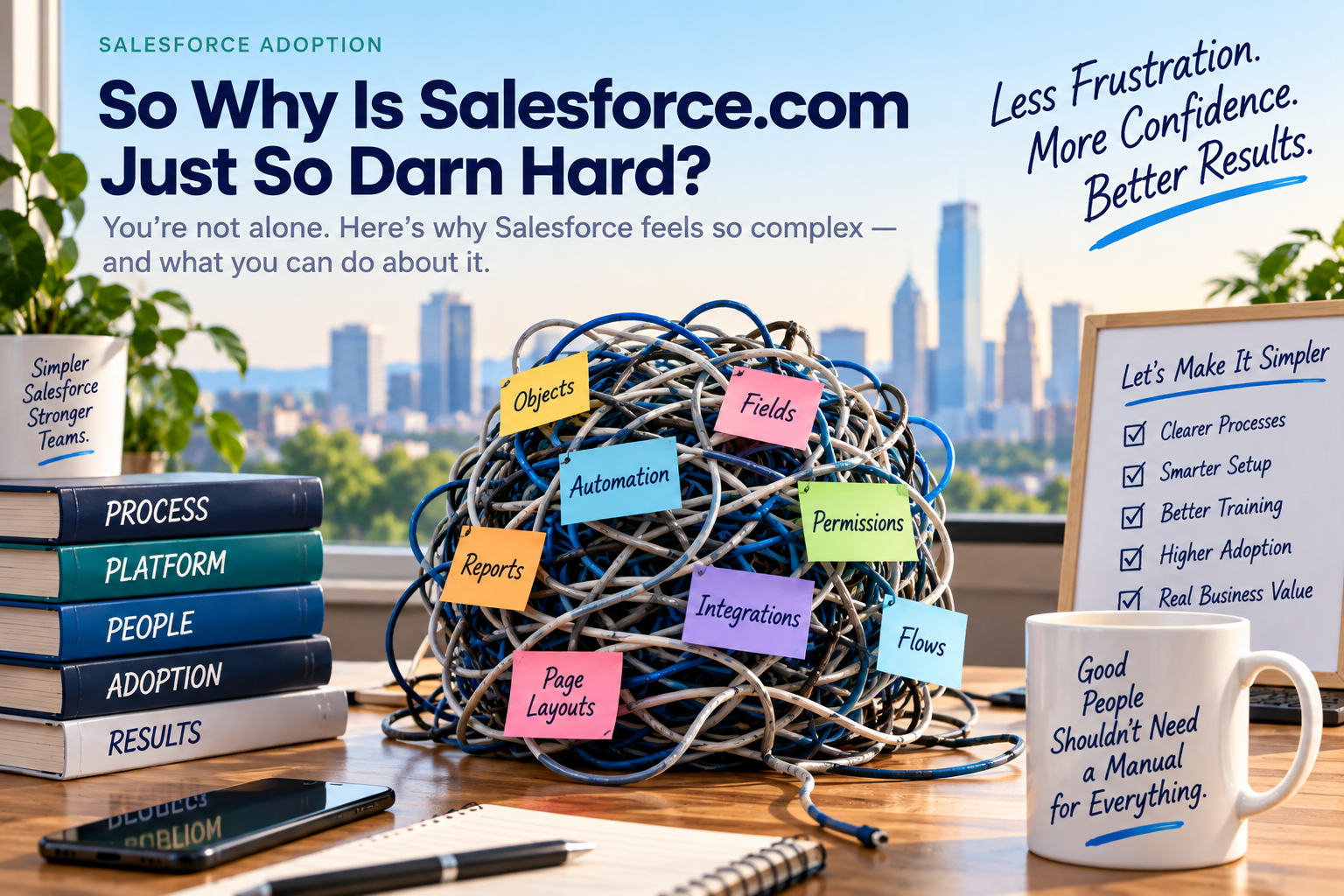
Salesforce has been around for years. It has become one of the most widely used CRM platforms in the world, and for good reason. When it is configured and used properly, it can give sales leaders valuable visibility into their pipeline, help managers coach their teams, and provide salespeople with a more structured way to manage their opportunities and customer relationships.
And yet, many companies still struggle to get the value they expected from it.
They invest in the platform, spend thousands of dollars on licenses and implementation, and then discover that their salespeople are using it primarily as a glorified contact list. Some users avoid entering information altogether. Others enter incomplete or unreliable data. Sales managers complain that they cannot trust the reports, while salespeople complain that Salesforce is too complicated and takes too much time.
So, why does this happen?
In my experience, Salesforce itself is rarely the real problem. More often, the problem is that the organization hasn't established the right foundation for the platform to succeed.
There are three issues that come up repeatedly:
An undefined or poorly documented sales process.
An overcomplicated or poorly configured Salesforce platform.
A lack of clearly defined performance objectives.
And now that AI is becoming increasingly integrated into Salesforce, getting these fundamentals right is more important than ever.
1. Your Sales Process Isn't Clearly Defined
If you take only one thing away from this article, let it be this:
Salesforce is designed to support and automate your sales process. It cannot define that process for you.
Before configuring Salesforce, an organization needs to understand how it actually sells.
What happens when a new lead comes in? Who follows up? How quickly should that happen? What qualifies a lead to move forward? When does a lead become an opportunity? What information must be captured before an opportunity can progress? What are the criteria for moving from one stage to the next? How are deals forecast? What happens after a deal closes?
These are sales-process questions. They need to be answered before the platform can be configured effectively.
Unfortunately, many organizations approach Salesforce from the opposite direction. They start by asking, “What can Salesforce do?” rather than asking, “What does our sales team need to accomplish, and how should our system support that?”
That can lead to a platform filled with fields, stages, automations, reports, and workflows that don't necessarily reflect how the business operates.
The result is predictable. Salespeople aren't sure what information they are expected to enter. Managers aren't sure what the data means. Different members of the sales team use Salesforce in different ways. And the organization ends up with a system that is technically functional but operationally ineffective.
A well-defined sales process should provide a clear, step-by-step outline of how your organization manages prospects, opportunities, customers, and revenue.
It should establish things such as:
How leads are generated, assigned, and followed up.
What makes a lead qualified.
When and why a lead becomes an opportunity.
What each opportunity stage actually means.
What information is required at each stage.
How salespeople are expected to manage their opportunities.
How managers review pipeline and forecast revenue.
What happens when a deal is won or lost.
How existing customers are managed after the sale.
Once that process is clearly defined, Salesforce can be configured to support it.
You cannot effectively automate a process that hasn't been defined.
This becomes even more important as AI takes on a greater role in sales. If you want AI to identify deals at risk, recommend next steps, assess pipeline health, or help managers coach their teams, it needs to understand the process behind the data.
If your opportunity stages are vague, your qualification criteria are inconsistent, and your salespeople follow different processes, AI will have a difficult time producing meaningful recommendations.
The quality of your AI output will depend, in part, on the quality of the sales process it is working within.
2. Your Salesforce Platform Is Too Complicated
Salesforce is an incredibly flexible platform. That flexibility is one of its greatest strengths, but it can also become one of its biggest weaknesses.
Over time, organizations often add more fields, objects, page layouts, automations, validation rules, reports, and features to the system. Individual additions may make sense when they are introduced, but the cumulative result can be a platform that is difficult to navigate and even harder to maintain.
Salespeople log in and see fields they don't understand, information they don't need, and processes that seem disconnected from the way they actually sell.
When that happens, users often respond in predictable ways:
They skip fields.
They enter inaccurate information.
They create workarounds.
They avoid using certain features.
They maintain their own spreadsheets.
They view Salesforce as an administrative burden rather than a sales tool.
This isn't necessarily a user problem. It may be a design problem.
Salesforce should be configured around the needs of the sales team — not around every feature the platform makes available.
That means making deliberate decisions about what users need to see, what information they need to capture, and what actions they need to take.
A salesperson may not need access to dozens of objects or hundreds of fields. They may need a focused workspace that helps them manage their accounts, follow up on activities, progress opportunities, and maintain accurate next steps.
A sales manager may need a different experience, with access to pipeline reports, forecast information, coaching metrics, and team performance data.
The platform should support the different roles within the organization without overwhelming users with unnecessary complexity.
This is where thoughtful Salesforce optimization becomes important. The objective isn't to activate more features. The objective is to make the system easier to use and more effective.
And as AI becomes more deeply integrated into Salesforce, platform design will matter even more.
AI can potentially help users find information, summarize records, identify risks, and recommend actions. But if the underlying platform is cluttered, inconsistent, or poorly structured, AI may have difficulty determining which information matters and how it should be interpreted.
Adding AI to a complicated system doesn't automatically make that system better.
The goal isn't to make Salesforce more complicated because AI is coming. The goal is to make Salesforce better.
3. You Haven't Defined What Success Looks Like
Another common problem is that organizations implement Salesforce without establishing clear, measurable objectives for what they want to improve.
“We want our sales team to be more productive” sounds reasonable, but it isn't a particularly useful goal.
How will you know whether productivity has improved? What specific business outcome are you trying to change? How will you measure progress?
Before implementing or optimizing Salesforce, an organization should identify the performance improvements it wants to achieve.
Depending on the business, those objectives might include:
Reducing sales-cycle time by 20%.
Increasing the number of qualified leads reaching the sales team.
Improving lead-to-opportunity conversion rates.
Increasing opportunity win rates.
Improving forecast accuracy.
Reducing the number of stalled opportunities.
Increasing the percentage of opportunities with documented next steps.
Improving the consistency and timeliness of sales activity updates.
The specific targets will vary from organization to organization. What matters is that the objectives are meaningful, measurable, and connected to business performance.
There is another important consideration: you need to understand your starting point.
If you want to improve your conversion rate from 25% to 40%, you first need to know whether your current conversion rate is actually 25%.
If you want to reduce your sales cycle by 20%, you need reliable data about how long your sales cycle currently takes.
This is one of the areas where Salesforce can provide tremendous value. When the system is properly configured and consistently used, it can help establish a reliable baseline and track performance over time.
It can also help sales managers identify where their teams need additional coaching and support.
For example, a manager might discover that opportunities are frequently getting stuck at a particular stage. That could indicate a qualification problem, a skills gap, an issue with the sales process, or a need for better coaching.
The data doesn't replace the manager's judgment. It gives the manager a better starting point for asking questions and taking action.
AI can potentially make this analysis faster and more accessible, but it still depends on having meaningful data and clearly defined performance measures.
If the organization hasn't decided what success looks like, AI may produce plenty of analysis without providing much direction.
The Other Problems That Get in the Way
The three issues above are foundational, but they aren't the only reasons Salesforce implementations struggle.
Other common challenges include:
Poor-quality or outdated data.
Inadequate training.
A lack of executive sponsorship.
Insufficient support for sales managers.
No clear ownership of the Salesforce platform.
A failure to reinforce expectations after implementation.
A disconnect between the system and the way salespeople are actually compensated or measured.
One of the most common problems I've seen is a lack of leadership adoption.
An organization may tell its salespeople that Salesforce is essential, while senior leaders and sales managers continue to rely on separate spreadsheets, private reports, or informal updates.
That sends a very clear message to the sales team: Salesforce may be mandatory, but it isn't really how the business operates.
If leaders expect salespeople to use Salesforce consistently, leaders need to use it themselves.
The same principle applies to training. Training is important, but a training session alone won't create lasting adoption.
People need to understand why the system matters, how it supports their work, and what is expected of them. Managers need to reinforce those expectations, and the organization needs to make adjustments when the system isn't working as intended.
Salesforce adoption is not a one-time training event. It's an ongoing management responsibility.
Process, Platform and People: The Foundation for Salesforce Success
At The Salesforce Trainers, we look at Salesforce effectiveness through three connected areas: Process, Platform and People.
Process
Your sales process needs to be clearly defined, practical, and aligned with the way your organization sells.
It should establish how opportunities are managed, how decisions are made, and what good sales execution looks like.
Platform
Your Salesforce environment needs to support that process without creating unnecessary complexity.
The system should be configured around the needs of your salespeople, managers, and business—not simply around the features available in Salesforce.
People
Your people need the skills, understanding, support, and motivation to use the system effectively.
That includes salespeople, sales managers, administrators, and executives. Everyone has a role to play in making Salesforce successful.
These three areas are interconnected.
A well-designed platform cannot compensate for a poorly defined process. A strong process won't deliver much value if the platform is difficult to use. And neither will succeed if the people responsible for using the system don't understand its purpose or see value in it.
AI adds another layer to this discussion, but it doesn't eliminate the fundamentals.
In fact, it makes them more important.
AI Won't Fix a Broken Sales System
There's a lot of excitement about what AI can do within Salesforce—and much of that excitement is justified.
AI has the potential to help salespeople prepare for meetings, summarize customer information, identify important trends, assess deal health, and determine where to focus their time.
Sales managers may be able to use AI to review pipeline, identify risks, and gain deeper insight into team performance.
Salesforce and Anthropic have also announced Claudeforce, which brings Claude AI into the Salesforce environment.
But AI isn't a substitute for a well-designed sales operation.
If your sales stages don't mean anything, AI won't magically give them meaning.
If your data is incomplete, AI won't necessarily know what is missing.
If your salespeople aren't following a consistent process, AI may be analyzing a collection of inconsistent behaviors rather than a reliable sales system.
And if your managers haven't established clear performance expectations, AI may provide information without a clear management response.
AI is only as good as the sales system you give it.
The organizations that get the most value from AI will likely be the ones that have already done the hard work of defining their processes, improving their platforms, establishing meaningful objectives, and aligning their people.
That work may not be as exciting as launching a new AI capability, but it is what gives the technology something useful to work with.
Don't Start With the Technology
When organizations are considering Salesforce, Salesforce optimization, or new AI capabilities, it's tempting to start with the technology.
What features are available? What can we automate? What can AI do for us? What new tools should we add?
Those are reasonable questions, but they shouldn't be the first questions.
Start with the business.
What are you trying to accomplish? How does your sales team work today? Where are the biggest gaps? What information do managers need to make better decisions? What do salespeople need in order to sell more effectively?
Then determine how Salesforce can support those requirements.
From there, you can decide which features to use, which processes to simplify, what information to capture, and where automation or AI can add genuine value.
The technology should serve the business—not the other way around.
Salesforce Doesn't Have to Be Difficult
Salesforce is a powerful platform, but power and complexity are not the same thing.
When organizations struggle with Salesforce, the answer isn't always more training, more features, or another technology investment.
Sometimes the answer is to step back and revisit the fundamentals.
Have you clearly defined your sales process?
Is your Salesforce platform configured to support that process?
Have you established measurable objectives?
Are your people properly trained, supported, and held accountable?
Are your sales managers using the system to coach and improve performance?
Are your leaders demonstrating the behaviors they expect from everyone else?
These questions may not be as exciting as discussing the latest AI developments, but they are essential to getting value from Salesforce.
And with AI becoming a more integral part of the platform, the stakes are even higher.
The organizations that prepare their process, platform, and people today will be in a much stronger position to take advantage of what AI can offer tomorrow.
Salesforce isn't inherently difficult to use.
But it does require thoughtful design, clear expectations, and ongoing commitment.
Get those things right, and Salesforce can become much more than a place to store customer information.
It can become a system that helps your salespeople sell, your managers manage, and your organization make better decisions.