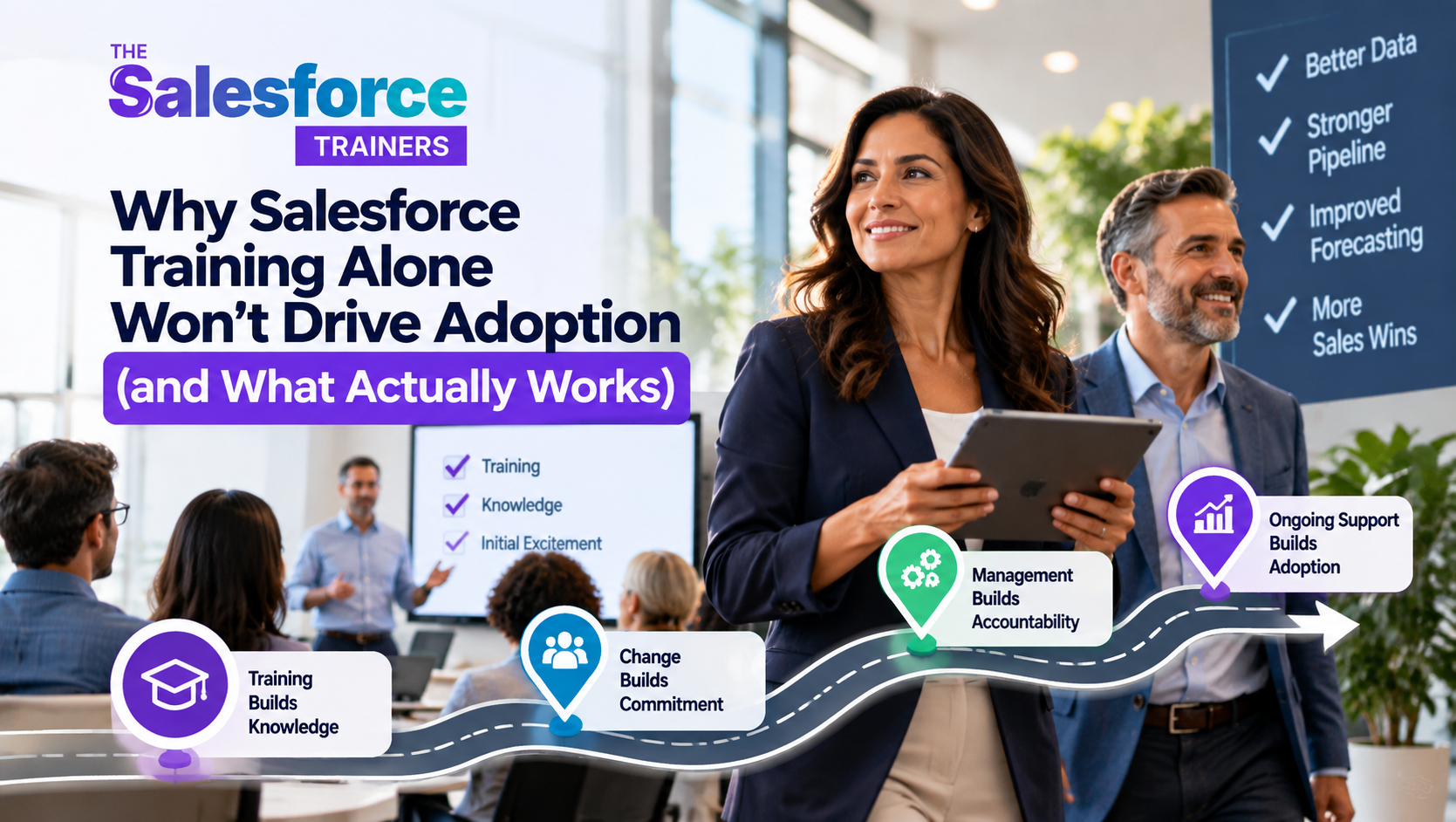
Why Salesforce Training Alone Will Not Drive Adoption
You've invested in Salesforce. You've hired an implementation partner, mapped out a project plan, configured the system, communicated the changes and delivered a training program to your sales team.
Everyone has attended the training. The implementation is complete. It's time to get on with business.
And then something unexpected happens.
Your salespeople aren't consistently updating Salesforce. Opportunities are missing information. Activities aren't being recorded. Managers are still chasing their teams for pipeline updates, and some salespeople have quietly returned to their old spreadsheets.
Sound familiar?
Here's the problem: you've trained your people to use Salesforce, but you haven't necessarily changed the way they work.
And there's a big difference between the two.
Training is an important part of Salesforce adoption. But even the best training program, on its own, won't create lasting behavioral change. For that, you need a much broader strategy that addresses the people side of the change.
Let's look at why training alone isn't enough and what you can do to make Salesforce adoption stick.
Training Teaches Skills. Adoption Changes Behaviors.
Let's start with a simple distinction.
Training helps people understand how to use Salesforce. They learn how to create records, update Opportunities, log activities, navigate reports and perform the tasks required in their roles.
But knowing how to do something doesn't necessarily mean someone will actually do it.
Think about your own experience with new technology or a new process. You might understand exactly how something works, yet still prefer doing things the old way.
Why?
Because changing established habits takes effort. People have routines, preferences and ways of working that have served them well. When a new system is introduced, even one that's intended to make life easier, there's often some resistance.
Salespeople are no different.
They may question why they're being asked to enter information that they previously kept in their own spreadsheets. They may believe Salesforce creates unnecessary administrative work. They may not trust the reports or understand how the information they're entering will be used.
And sometimes, quite frankly, they're right. The system may be poorly designed, the process may be unclear, or the promised benefits may never materialize.
This is why Salesforce adoption isn't simply a training problem.
It's a change management problem.
Why Salespeople Resist Salesforce
One of the biggest mistakes organizations make is assuming that introducing better technology will naturally create enthusiasm for using it.
It doesn't.
When you introduce Salesforce, salespeople are likely to have questions:
Why are we changing the way we work?
What's wrong with our current process?
How is this going to make my job easier?
Is this just another way for management to monitor me?
Does senior leadership actually believe in this change?
What happens if I struggle with the new system?
These are perfectly reasonable questions.
If you don't address them, people will form their own conclusions. And those conclusions may not align with what leadership intended.
This is why communication needs to begin well before the first training session.
Senior leadership should explain why the organization is making the change, what business outcomes it's trying to achieve and why the initiative matters.
Frontline sales managers have a different but equally important role. They need to explain how the change affects each salesperson personally and why adopting Salesforce is worthwhile for them.
This is the classic What's In It For Me? conversation.
And it shouldn't be delivered once at the beginning of a training session. It needs to be reinforced through regular conversations, management behavior and visible support.
Use ADKAR to Manage the People Side of Change
One of the most useful frameworks for managing change is Prosci's ADKAR model.
ADKAR identifies five outcomes that individuals need to achieve for a change to be successful:
Awareness: Understanding why the change is necessary.
Desire: Having the motivation and willingness to participate.
Knowledge: Knowing how to change.
Ability: Being able to apply the required skills and behaviors.
Reinforcement: Receiving the support needed to sustain the change.
Notice where training fits.
Training primarily addresses Knowledge. It helps people understand how to use Salesforce and what they're expected to do.
But knowledge is only one part of the equation.
You can deliver an outstanding training program, but if people don't understand why the change is happening, don't want to participate, struggle to apply what they've learned or receive no reinforcement afterward, adoption is likely to suffer.
That's why the order matters.
Before you train, make sure people understand the need for change and have a reason to support it. After training, give them the opportunity, support and reinforcement they need to apply their new skills.
Training is one milestone in the adoption journey, not the finish line.
The Real Test Begins After Training
Imagine one of your salespeople has just completed a Salesforce training session.
They understand how to create an Opportunity, update a stage, log a call and record next steps.
The following morning, they're out visiting customers.
They finish a meeting, get into their car and try to record the conversation on their phone. The mobile interface looks different from the desktop version they used in training. They can't immediately find the right action, aren't sure where to enter their notes and don't remember exactly which fields are required.
They're in a hurry to get to their next appointment.
So they decide to update Salesforce later.
Later becomes the end of the day. Then tomorrow. Eventually, the information is either entered incompletely or not entered at all.
Was that a training failure?
Not necessarily.
It may be a combination of inadequate practice, a cumbersome mobile experience, unclear processes and insufficient support during the transition.
The salesperson needs more than the knowledge they gained in class. They need to develop the ability to use Salesforce effectively in the actual conditions of their job.
That requires practice, coaching, accessible resources and time.
And most importantly, it requires managers who recognize that learning doesn't end when the training session does.
What Actually Drives Salesforce Adoption?
If classroom training alone isn't enough, what else should organizations be doing?
There are several important elements.
1. Make Salesforce Easier to Use
Let's begin with the platform itself.
If your Salesforce environment is complicated, inconsistent or poorly aligned with the way salespeople work, adoption is going to be difficult.
Consider the everyday experience of a salesperson.
Can they quickly find the information they need? Is it easy to update an Opportunity? Can they record customer interactions without navigating through unnecessary fields and screens? Does the mobile experience support their work in the field?
Every unnecessary step introduces friction.
And when the system creates more work than it removes, salespeople have a strong incentive to find alternatives.
That's why it's important to regularly evaluate your Salesforce platform and make sure it supports the actual needs of your sales organization.
Technology should enable the process, not get in the way of it.
2. Equip Sales Managers to Lead the Change
If there's one group that can make or break Salesforce adoption, it's your frontline sales managers.
They interact with salespeople every day. They conduct pipeline reviews, coach deals, discuss performance and establish expectations.
Their behavior sends a powerful message about what really matters.
If managers continue to run their teams using spreadsheets, personal notes and information gathered outside Salesforce, salespeople will quickly recognize that Salesforce isn't truly essential.
But when managers use Salesforce during one-on-ones, pipeline reviews, forecasting and coaching conversations, the system becomes part of how the organization actually operates.
Managers also need to be comfortable with Salesforce themselves.
They don't have to be administrators or technical experts. But they should know how to navigate the platform, interpret the information it provides and use it to guide meaningful conversations.
This is why sales manager enablement is such an important part of our ProSell program.
The objective isn't simply to train salespeople. It's to equip managers with the tools, coaching practices and roadmap to lead adoption within their teams.
3. Provide Ongoing Learning and Support
Here's where the question about tools that help drive adoption without classroom training becomes particularly relevant.
Yes, there are plenty of ways to support Salesforce adoption outside formal training sessions.
In fact, some of the most useful learning happens in short, focused moments while people are doing their actual work.
Depending on your Salesforce environment and available tools, consider:
Short instructional videos: Quick demonstrations showing how to complete common tasks.
Step-by-step guides: Simple reference materials that salespeople can access when they get stuck.
In-app guidance: Contextual prompts and walkthroughs that help users complete tasks within the platform.
Role-specific learning paths: Different learning resources for salespeople, managers, Sales Ops and administrators.
Office hours and drop-in support: Regular opportunities to ask questions and resolve problems.
Salesforce champions: Experienced users who can provide practical peer support.
Manager-led coaching: Regular conversations that reinforce the expected behaviors and address individual challenges.
These tools aren't substitutes for a well-designed training program in every situation. They're ways to extend learning, reduce friction and support people as they put their knowledge into practice.
The important thing is to match the support to the challenge.
If someone doesn't understand how to create an Opportunity, a short guide or demonstration may be sufficient.
If someone doesn't believe Salesforce is useful or doesn't understand why they need to update it, another tutorial probably won't solve the problem.
That requires communication, management and a broader change strategy.
4. Define the Sales Process Before Expecting Adoption
Here's another common issue.
Organizations often focus heavily on teaching salespeople how to use Salesforce without first defining exactly how they expect their sales teams to sell.
What qualifies an Opportunity? When should a salesperson move it to the next stage? What information should be captured? How should managers review pipeline? What constitutes a meaningful next step?
If those expectations aren't clear, salespeople will use Salesforce in different ways.
One salesperson might consider an Opportunity qualified when a prospect expresses general interest. Another might wait until there's an identified business need and a clear next step.
Both may believe they're doing the right thing.
The result is inconsistent data, unreliable reporting and frustration among managers who are trying to understand what's happening in the pipeline.
Before you can expect consistent Salesforce usage, you need a consistent sales process.
That's why our approach begins with Sales Process Consulting.
You can't reinforce a process that hasn't been clearly defined.
5. Reinforce the Behaviors You Want to See
The final step is reinforcement.
People need to see that the new way of working is not a temporary initiative that will disappear once the implementation team moves on to its next project.
Managers need to recognize positive behavior, address recurring problems and consistently use Salesforce as part of their normal management routines.
Leadership needs to continue communicating the importance of the initiative and demonstrate its commitment through decisions and actions.
And the organization needs to monitor whether the change is actually producing the intended results.
That means looking beyond training attendance and login statistics.
Are salespeople consistently updating their Opportunities? Are managers using Salesforce during pipeline reviews? Is the quality of the data improving? Are the new processes helping the organization make better decisions?
Those are much more meaningful measures of adoption.
Reinforcement isn't about policing every click or turning Salesforce into a surveillance tool.
It's about making the desired behaviors part of the way the organization works.
Salesforce Adoption Is a Process, Platform and People Challenge
By now, you may have noticed a pattern.
The challenges we've discussed aren't isolated training issues. They're connected to three fundamental elements of successful Salesforce adoption.
Process: Your sales organization needs a clearly defined way of working, with expectations that Salesforce can support.
Platform: Salesforce needs to be configured to make those processes practical, efficient and accessible to the people using it.
People: Your salespeople and managers need the awareness, motivation, knowledge, ability and reinforcement to make the change stick.
This is the foundation of our P3 Framework.
When these three elements are aligned, training becomes much more effective because people understand what they're learning, why it matters and how to apply it.
When they're not aligned, even excellent training can struggle to produce lasting results.
Don't Measure Success by Training Attendance
It's tempting to declare success when everyone has completed their Salesforce training.
But attendance tells you very little about whether people have actually changed the way they work.
A more useful approach is to define the behaviors and business outcomes you expect to see, then measure progress over time.
For example:
Are salespeople updating Salesforce consistently?
Are Opportunities progressing through the defined sales stages?
Are next steps being recorded and followed up?
Are managers using Salesforce to coach and manage?
Is the organization getting more reliable pipeline and forecast information?
Are salespeople spending less time on unnecessary administrative work?
You don't need to measure everything. Focus on the behaviors that matter most to your sales process and the business outcomes you're trying to achieve.
Then use those measures to identify where additional coaching, support or platform improvements are needed.
Adoption isn't a one-time event. It's an ongoing management responsibility.
Training Is the Beginning, Not the End
Salesforce is a powerful platform, but simply implementing it doesn't guarantee that your organization will realize its full potential.
You can hire an excellent implementation partner, build a well-designed system, communicate the change and deliver a great training program.
But if people don't understand why they're changing, don't see value in the new approach, struggle to apply what they've learned or receive no reinforcement from their managers, the results will probably disappoint.
That's why we believe successful Salesforce adoption requires much more than classroom training.
It requires a clearly defined sales process, a platform designed around the needs of the people using it, and a deliberate effort to help those people change their behavior.
Training teaches people how to use Salesforce. Adoption is what gets them to actually use it.
And that difference is where the real business value begins.