Drive Salesforce Adoption After Training: 6 Steps
The training is over.
The sandwiches are gone, the coffee is cold, everyone has learned how to create an Opportunity, update a Contact and run a report, and the trainer has packed up and left.
It feels like the Salesforce implementation is finished.
It isn't.
Salesforce training is the beginning of adoption—not the end of it.
This is where many organizations get into trouble. They invest significant time and money in configuring Salesforce and training their sales team, and then assume people will naturally continue using what they've learned.
They won't.
Learning how to use Salesforce and actually incorporating Salesforce into the way your sales team works are two different things.
The real challenge begins when the training is over and everyone goes back to doing their jobs.
That's when sales managers become critical.
Salesforce Adoption Starts With Management
If you want your sales team to consistently use Salesforce, management has to use it too.
That sounds obvious, but it's one of the most common reasons Salesforce adoption falls short.
Imagine telling your sales team that Salesforce is the company's system of record, and then asking them for their pipeline in an Excel spreadsheet.
Or telling them to keep their opportunities current, but never looking at Salesforce during your sales meetings.
Or requiring salespeople to document customer activity while managers continue to rely on their own notes.
The message becomes pretty clear: Salesforce isn't actually how we run the business.
Salesforce adoption doesn't happen because you tell employees to use Salesforce. It happens when Salesforce becomes part of the way the business is managed.
That means sales managers need to reinforce the behaviors introduced during training and demonstrate that the information in Salesforce actually matters.
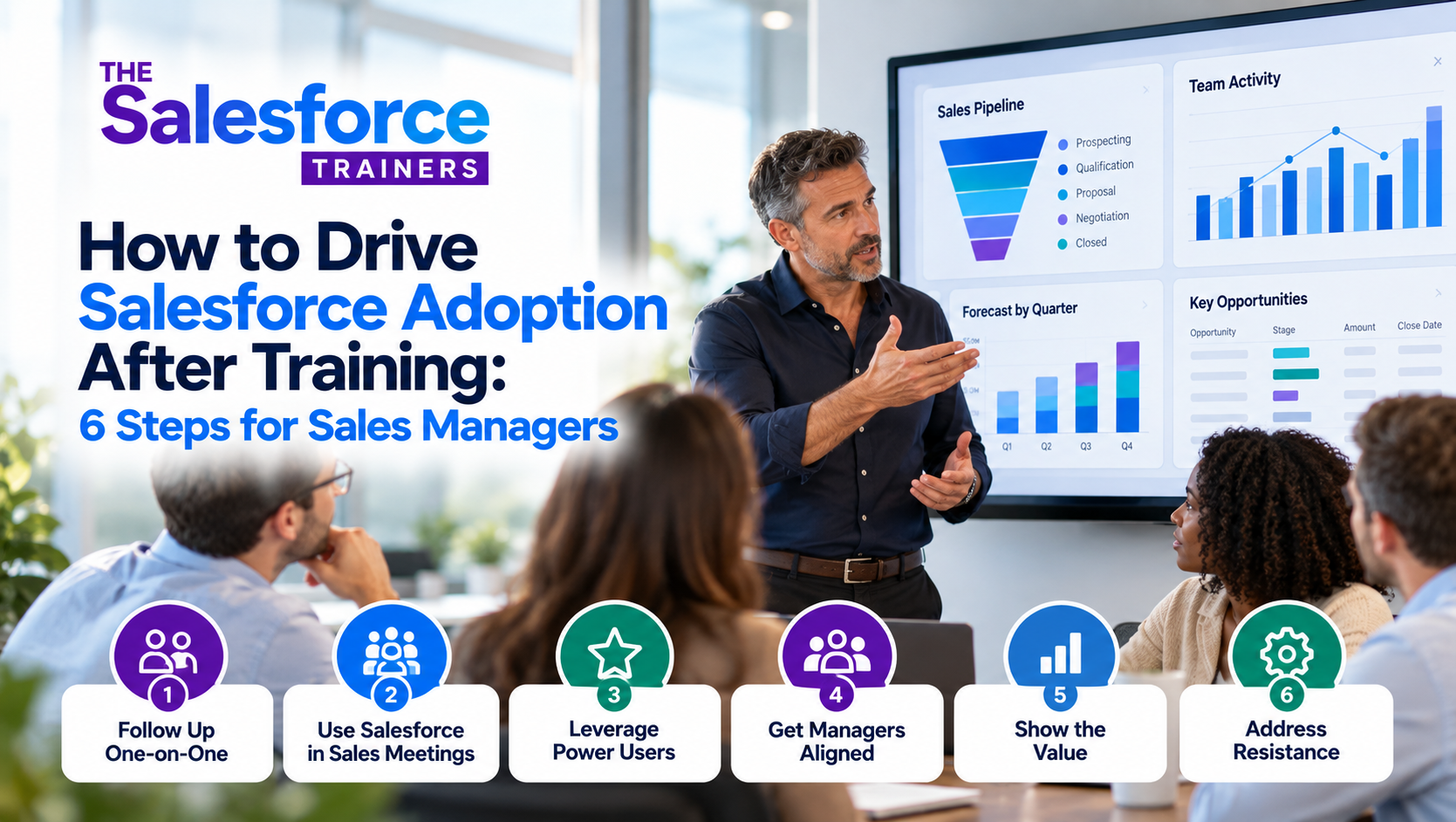
Here are six practical steps that can help make that happen.
Step 1: Follow Up With One-on-One Knowledge Checks
Not everyone learns Salesforce at the same pace.
Some people are comfortable asking questions during training. Others aren't.
Some salespeople understand the concepts immediately but struggle when they're sitting in front of Salesforce by themselves a week later.
That's why one-on-one follow-up matters.
A short knowledge check can uncover problems before they become habits.
Don't simply ask, “Do you understand how to use Salesforce?”
Ask the salesperson to demonstrate something.
“Walk me through how you would update this opportunity.”
“Show me how you would log the customer call.”
“What would you do if this opportunity moved to the next stage?”
The objective isn't to test people or catch them doing something wrong.
It's to identify where additional coaching is needed.
This is particularly important immediately after training, when people are trying to translate what they learned in a classroom or virtual session into their actual sales workflow.
For organizations looking for more structured reinforcement, Salesforce Adoption & Change Management should be treated as an ongoing process rather than a single training event.
Step 2: Put Salesforce at the Center of Your Sales Meetings
This may be the single most important thing a sales manager can do.
Once training is complete, don't hold another sales meeting without Salesforce being part of the conversation.
Discuss pipeline using Salesforce.
Review forecasts using Salesforce.
Talk about key accounts using Salesforce.
Look at opportunities that have stalled using Salesforce.
Use Salesforce information when discussing performance and coaching.
The first few meetings may be a little awkward.
That's okay.
The team is learning a new management rhythm, and the data may not be perfect yet.
But the message is powerful: this is how we run the sales organization now.
If managers consistently use Salesforce during sales meetings, salespeople quickly understand that keeping the information current isn't optional.
More importantly, they begin to understand why the information matters.
Step 3: Let Your Power Users Demonstrate the Value
Every organization has people who adopt new technology faster than others.
They figure things out.
They find shortcuts.
They discover reports that save them time.
They start using Salesforce in ways that make their jobs easier.
Use those people.
Have your Salesforce power users demonstrate what they're doing for the rest of the team.
Maybe someone has created a useful dashboard.
Maybe they've figured out how to organize their pipeline more effectively.
Maybe they're using Salesforce reports to prepare for their weekly one-on-one with their manager.
Maybe they're using the mobile app to update information while they're in the field.
The point isn't to tell everyone, “Look how great Salesforce is.”
It's to show a salesperson something much more persuasive:
“Here's how another salesperson is using Salesforce to make their own job easier.”
That's a much better adoption message.
If someone can demonstrate that Salesforce saves them time or gives them better visibility into their business, the value becomes real.
Step 4: Get Sales Managers Working Together on Adoption
Salesforce adoption shouldn't depend entirely on one manager figuring it out alone.
If you have multiple sales managers, regions or teams, get those managers together regularly to discuss what's working.
Which Salesforce reports are managers actually using?
What are salespeople responding well to?
Where are people struggling?
Which teams have strong adoption?
What are those managers doing differently?
This creates an opportunity to share practical ideas rather than simply talking about adoption as a corporate initiative.
It also helps identify inconsistencies.
If one sales manager is conducting excellent Salesforce-based pipeline reviews while another is maintaining a separate spreadsheet, you've got an organizational problem—not simply a user-adoption problem.
Your Salesforce administrator should also be part of these conversations.
Sales managers understand the business and the sales process. The Salesforce admin understands the platform.
You need both perspectives to determine whether a problem is related to process, configuration or user behavior.
That's one reason we use the P3 Framework: Process first. Platform second. People throughout.
Step 5: Show People the Value of Salesforce
People are more likely to adopt something when they understand what's in it for them.
That applies to executives, managers and salespeople.
For executives, Salesforce might provide better visibility into pipeline and revenue.
For sales managers, it might make pipeline reviews and coaching more effective.
For salespeople, it should make it easier to manage opportunities, prioritize their time and stay organized.
Find those sources of value and make them visible.
For example, if a sales manager has built a particularly useful dashboard, use it during the management meeting.
If Salesforce gives leadership better visibility into pipeline, demonstrate how that information is being used to make decisions.
If a salesperson is saving time because they no longer have to maintain a separate Excel pipeline, let other salespeople know.
The more people see Salesforce producing something useful, the less it feels like an administrative requirement.
Adoption improves when people can see the value of the behavior you're asking them to adopt.
Step 6: Address Resistance Before It Becomes the Culture
Not everyone will embrace Salesforce immediately.
Some people will resist because they don't like change.
Others may have legitimate concerns about the process or the technology.
And some may simply have developed their own way of working and don't see a reason to change it.
Don't ignore resistance.
Small problems can become bigger problems when they're allowed to continue unchecked.
If one salesperson routinely refuses to update Salesforce and nothing happens, other people notice.
If managers continue accepting information from spreadsheets instead of Salesforce, people notice.
If leadership says Salesforce is mandatory but doesn't enforce the expectation, people notice.
The answer isn't to punish people into using the system.
The answer is to understand why they're resisting and determine whether the problem is related to training, process, configuration, management or simply accountability.
Sometimes the salesperson needs additional coaching.
Sometimes the Salesforce configuration genuinely needs to change.
Sometimes the sales process isn't clear.
And sometimes the expectation simply needs to be reinforced by the manager.
The sooner you identify the problem, the easier it is to fix.
Salesforce Adoption Isn't a Training Problem
This is the bigger lesson.
When Salesforce adoption is poor, organizations often respond by scheduling more training.
Sometimes that's exactly what's needed.
But more training won't solve every adoption problem.
If the sales process is unclear, training won't fix it.
If Salesforce is unnecessarily complicated, training won't fix it.
If managers don't use Salesforce, training won't fix it.
If salespeople don't see the value, training won't fix it.
If nobody reinforces the behavior after training, training won't fix it.
That's why we look at Salesforce adoption through three connected areas:
Process. Platform. People.
The process needs to make sense.
The Salesforce platform needs to support that process.
And the people—including managers—need to consistently use and reinforce it.
Training is part of the People component, but it isn't the entire solution.
Don't Stop at Salesforce Training
A successful Salesforce implementation shouldn't end when everyone completes training.
That's when the real adoption work begins.
Sales managers need to incorporate Salesforce into their meetings.
They need to coach people on how to use it.
They need to reinforce expectations.
They need to demonstrate its value.
And they need to address resistance when it appears.
The objective isn't simply to get everyone logging into Salesforce.
The objective is to make Salesforce part of the way your sales organization operates.
Don't measure the success of Salesforce training by whether people know how to use Salesforce. Measure it by whether they actually use it to manage and improve the business.
That's where training turns into adoption.
And that's where the investment in Salesforce begins to produce a real return.
If your organization has completed Salesforce training but adoption still isn't where you want it to be, we can help you identify what's getting in the way and build a practical adoption plan.