How to Learn Salesforce: Choosing the Right Training Path
We get a lot of questions from people who want to learn Salesforce.
Sometimes it's an individual who has just started using Salesforce and wants to understand it better.
Sometimes it's someone who wants to become a Salesforce Administrator.
Sometimes it's someone considering a career in the Salesforce ecosystem.
And sometimes it's a company that has just invested heavily in Salesforce and needs its sales team, managers, administrators or other employees to actually know how to use it.
Those are very different training needs.
And that's the first thing I'd tell anyone trying to figure out how to learn Salesforce:
Don't start by asking, "What's the best Salesforce training?"
Start by asking:
"What am I trying to accomplish?"
Because the right way to learn Salesforce depends entirely on what you want to do with it.
Salesforce Is a Big Platform
The first thing to understand is that Salesforce isn't one skill.
It's a very large platform with different products, roles and areas of specialization.
A salesperson using Sales Cloud has a very different learning requirement from someone who administers Salesforce.
An administrator has a different learning path from a developer.
A consultant needs a different combination of technical and business skills.
And someone who simply wants to become more effective using Salesforce at work doesn't need to learn how to configure the platform at all.
That's why trying to learn everything about Salesforce is a mistake.
You need to decide what role Salesforce is going to play in your career or your job, and learn accordingly.
First Question: Are You Learning Salesforce for Your Job?
If you're already using Salesforce at work, you probably don't need to become a Salesforce Administrator.
You need to become better at using the parts of Salesforce that matter to your job.
For a salesperson, that might mean learning how to:
- Manage Leads
- Manage Accounts and Contacts
- Create and manage Opportunities
- Track activities
- Maintain pipeline
- Understand reports and dashboards
- Manage next steps
- Use Salesforce to prepare for customer conversations
For a sales manager, the requirements are different.
You need to understand how to use Salesforce to:
- Inspect pipeline
- Coach salespeople
- Review Opportunities
- Manage forecasts
- Identify risks
- Understand sales activity
- Run effective pipeline reviews
- Use Salesforce data to improve performance
And that's an important distinction.
Learning Salesforce isn't necessarily about learning Salesforce. It's about learning how to use Salesforce to do your job better.
That's why we believe training should be connected to the sales process and the way the organization actually works.
If You're Training a Salesforce Team, Start Somewhere Else
If you're responsible for training an entire sales organization, I wouldn't recommend simply handing everyone a generic Salesforce course.
Your Salesforce environment is configured around your business.
Your sales process is different.
Your Opportunity stages are different.
Your required information is different.
Your reports are different.
Your managers have different expectations.
So the training should reflect those things.
The best Salesforce training is usually the training that makes the connection between the platform and the job people are actually being asked to do.
That's why customized, role-based training can be much more useful for a company than simply putting everyone through the same generic Salesforce curriculum.
If You're Learning Salesforce for a Career, That's Different
If your goal is to become a Salesforce professional, then you have a much bigger learning journey ahead of you.
And that's where Salesforce's own Trailhead becomes extremely useful.
Trailhead is Salesforce's free learning platform. It provides hands-on learning through modules, projects, trails and other learning experiences, and Salesforce continues to add content as the platform evolves.
Salesforce also provides role-based career paths for people interested in becoming administrators, developers, consultants, architects and other Salesforce professionals.
That's a much better starting point than simply searching Google for:
"How do I learn Salesforce?"
Start by deciding which Salesforce role you're pursuing.
Trailhead Is Probably Your First Stop
If you're an individual trying to learn Salesforce, I'd start with Trailhead.
And there's a very good reason.
It's free.
More importantly, it isn't simply a collection of videos.
Trailhead combines learning content with hands-on exercises and Salesforce environments where you can actually practice what you're learning. Salesforce describes Trails as guided learning paths made up of modules and projects, while Superbadges allow learners to apply skills to more realistic business problems.
That hands-on component matters.
You don't really learn Salesforce by reading about Salesforce.
You learn Salesforce by using it.
Start Learning Salesforce on Trailhead
But Don't Just Wander Around Trailhead
Here's where beginners can get themselves into trouble.
Trailhead has a lot of content.
That's one of its greatest strengths.
It's also one of its biggest weaknesses for someone who doesn't know where to start.
You can jump from one module to another, collect badges and points, and feel like you're making progress without necessarily developing a coherent set of skills.
Instead, pick a destination.
For example:
"I want to become a Salesforce Administrator."
Now you have a much clearer path.
Salesforce currently provides a dedicated Platform Administrator certification path and specific Trailhead preparation content for the certification.
That's much better than simply collecting random badges.
What About Salesforce Certification?
Certification can be valuable.
But don't confuse passing a certification exam with knowing how to do the job.
They're related.
They're not the same thing.
A certification demonstrates that you've met the requirements of a particular Salesforce credential. Salesforce organizes its certifications around different roles and specialties, and the exam guides describe the knowledge and experience expected for each credential.
But if your ultimate goal is to become a Salesforce Administrator, Consultant or other Salesforce professional, you need more than the ability to answer multiple-choice questions.
You need experience.
You need to understand why Salesforce is configured the way it is.
You need to understand business processes.
You need to understand data.
And eventually, you need to be able to solve problems.
Don't study just to pass the exam. Study to become capable.
Instructor-Led Training Still Has a Place
I'm obviously going to be biased here, but I still believe there is a place for instructor-led Salesforce training.
Not because everyone needs it.
They don't.
But because sometimes having an experienced instructor in the room dramatically accelerates the learning process.
An instructor can:
- Explain a difficult concept immediately
- Answer questions specific to your situation
- Demonstrate how something works
- Correct misunderstandings
- Provide real-world examples
- Give you structured practice
- Keep you moving when you're struggling
And there's something else that's difficult to replicate with self-paced learning:
You can ask "Why?"
That's often where the real learning happens.
Salesforce also offers instructor-led training through Trailhead Academy, with courses searchable by product, role and level.
When Should You Consider Paid Training?
I'd consider paid training when one of three things is true.
1. You need to learn quickly
If you have a job requirement or project deadline, spending months wandering through self-paced content may not make sense.
2. You're struggling to connect the dots
You may understand individual Salesforce features but not understand how they fit together.
That's often when an instructor or experienced mentor becomes valuable.
3. You need to learn how Salesforce works in your organization
This is particularly important for companies.
Generic Salesforce training can teach you how Salesforce works.
Customized training can teach your people how your Salesforce works.
Those are two very different things.
Don't Ignore the Sales Process
This is especially important for sales teams.
If you're teaching salespeople how to use Salesforce, don't start with:
"Here's what this button does."
Start with:
"Here's how we sell."
Then show them how Salesforce supports that process.
If your sales process says that a salesperson needs to understand a customer's business problem before creating a qualified Opportunity, Salesforce training should reinforce that behavior.
If your sales process requires specific information before an Opportunity progresses to the next stage, training should explain why that information matters.
Salesforce training should support your sales process — not exist separately from it.
Salesforce Platform Optimization
And Don't Forget the People Side
Learning Salesforce isn't just about knowledge.
It's about behavior.
Someone can attend eight hours of Salesforce training and still not use Salesforce effectively six months later.
Why?
Because knowing how to use Salesforce and actually changing the way you work are two different things.
That's why Salesforce adoption requires more than training.
People need clear expectations.
Managers need to reinforce those expectations.
The platform needs to make sense.
And the organization needs to understand why Salesforce matters.
Salesforce Adoption & Change Management
What About Practice Exams?
If you're pursuing certification, practice exams can be useful.
But I'd put them toward the end of your learning process.
Don't spend your time memorizing answers.
Learn the material first.
Then use practice exams to identify the areas where your knowledge isn't strong enough.
That's a much better way to prepare.
And I would strongly avoid certification exam dumps.
They're not a substitute for learning the material, and they undermine the value of the certification you're trying to earn.
Learn the skills. Then prove that you know them.
Salesforce Is Changing — So Your Learning Can't Stop
There's another consideration that wasn't nearly as important when the original version of this article was written.
Salesforce is changing rapidly.
AI, Agentforce, Data Cloud, new platform capabilities and new certifications are changing what Salesforce professionals need to understand.
Salesforce's current Trailhead content reflects that shift, with learning paths covering CRM, data, AI and agentic AI skills.
And Salesforce has announced that 24 certifications will retire on February 1, 2027, leaving a portfolio of 63 certifications.
That's a good reminder of something important:
Don't build your career around one certification. Build it around your ability to solve business problems.
The technology will continue to change.
The underlying skills — understanding customers, processes, data, systems and business problems — remain valuable.
So, What's the Best Way to Learn Salesforce?
If you're looking for the simplest answer, here's mine.
If you're a Salesforce user:
Start with training that focuses on your role and your company's Salesforce environment.
If you're learning Salesforce for a career:
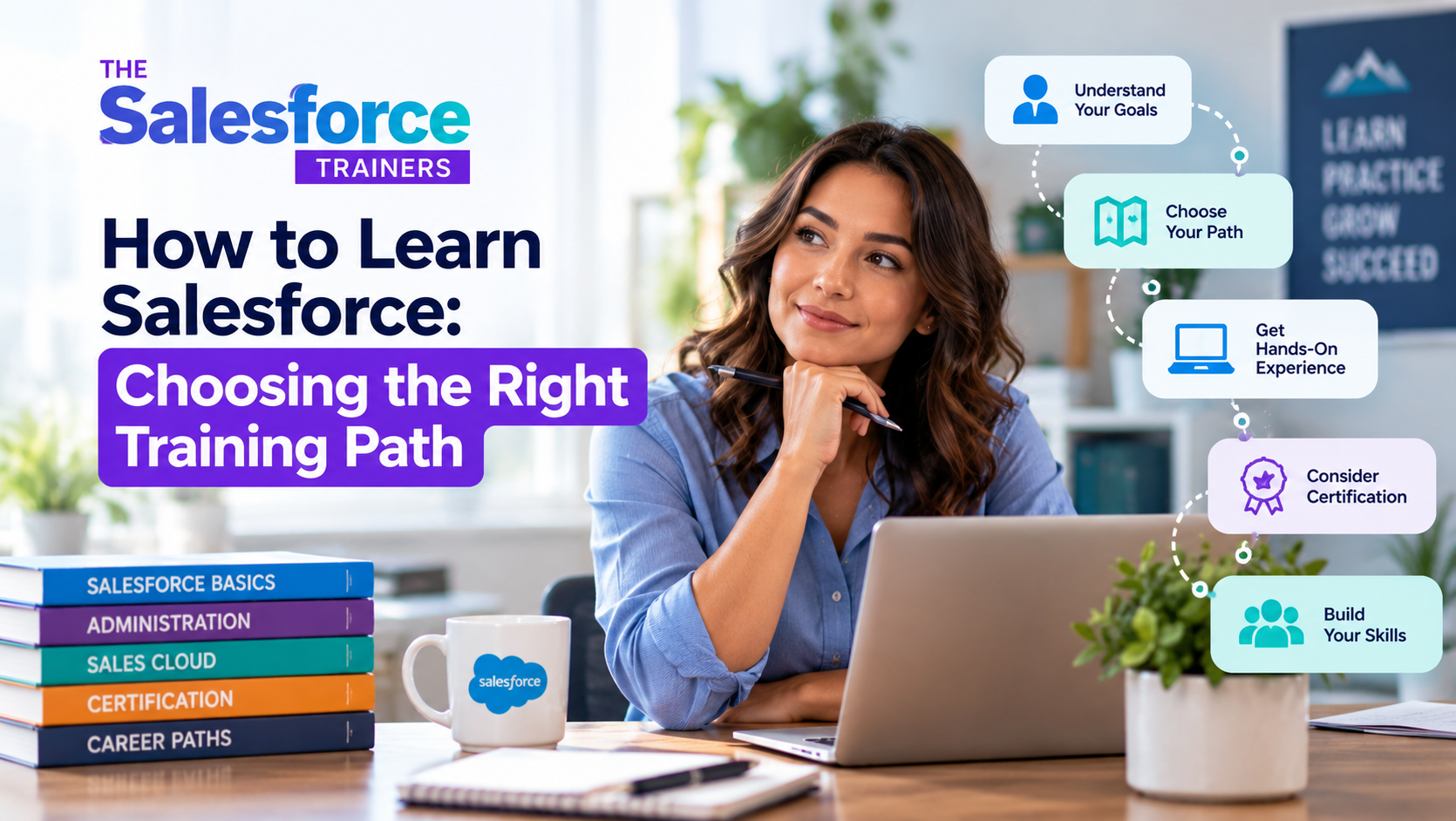
Start with Trailhead, choose a specific role, follow the appropriate learning path, get hands-on experience and then consider certification. Salesforce itself recommends combining learning, credentials and community/networking as part of a career plan.
If you're responsible for training a Salesforce team:
Don't just buy generic training.
Start with your sales process, your Salesforce platform and your people.
Then build training around what they actually need to accomplish.
If you're stuck:
Get help.
Sometimes the fastest way to learn something is to have someone who's already figured it out show you how.
You Don't Need to Know All of Salesforce
This might be the most important thing I can tell someone who is just getting started.
Nobody knows all of Salesforce.
The platform is simply too large and changes too quickly.
You don't need to know everything.
You need to know what you need to know.
Choose your role.
Choose your learning path.
Get hands-on experience.
Learn from people who have done the work.
And keep learning as the platform evolves.
For companies, the same principle applies.
Don't try to teach your salespeople everything Salesforce can do.
Teach them what they need to know to sell effectively.
That's a much better definition of Salesforce training.