How Long Should Salesforce Training Actually Take?
One of the first questions we hear when a company is implementing Salesforce is:
“How much training are our salespeople going to need?”
Two hours?
Four hours?
A full day?
Maybe a couple of days?
It's a reasonable question. Training takes time, and time costs money. Salespeople have customers to meet, opportunities to manage, and revenue targets to hit.
But there's a problem with the question.
You're probably asking it too early.
The more important question isn't how many hours of Salesforce training do we need?
It's:
What will it take to get our salespeople using Salesforce effectively?
Those are two very different questions.
Salesforce Isn't an iPhone
We've become accustomed to technology that requires very little formal training.
Buy a new phone, turn it on, and start using it.
You might need someone to show you a few things, but most modern technology is designed to be intuitive enough that you can figure out the basics yourself.
Salesforce is different.
It's a sophisticated CRM platform that can be configured and customized extensively. And the Salesforce your company implements isn't necessarily going to look or behave like the Salesforce another company uses.
Your organization may have different:
- Objects and fields
- Page layouts
- Sales stages
- Required information
- Validation rules
- Reports and dashboards
- Workflows and automation
- Sales processes
- Business rules
That's why Salesforce training can't simply be a generic demonstration of what the software can do.
Your salespeople need to learn how Salesforce works in the context of how your organization actually sells.
And that's a much bigger undertaking than showing someone where to click.
So, How Many Hours of Salesforce Training Do You Need?
Here's the answer you're probably looking for:
There isn't one number.
For a salesperson learning a reasonably straightforward Salesforce implementation, we have historically found that roughly five to six hours of focused, role-specific training can provide a solid foundation.
But that doesn't mean you should take that number and put six hours on everyone's calendar.
The amount of training required depends on several factors.
1. How complicated is your Salesforce implementation?
A relatively straightforward Sales Cloud implementation may be easier to learn than a heavily customized Salesforce environment with complex automation, multiple objects, complicated sales processes and extensive reporting.
The more your Salesforce environment differs from the standard Salesforce experience, the more your users have to learn.
2. How much does Salesforce affect the salesperson's job?
This is an important one.
If Salesforce is primarily being used to enter Opportunities and update a few fields, the learning curve may be relatively modest.
But if Salesforce is expected to become the salesperson's primary tool for managing:
- Leads
- Accounts
- Contacts
- Opportunities
- Activities
- Tasks
- Pipeline
- Forecasting
- Reports
- Dashboards
then there's considerably more to learn.
3. How well defined is your sales process?
This may be the biggest factor of all.
If your salespeople already have a clearly defined sales process and Salesforce has been configured to support it, training becomes much easier.
You're teaching people how to execute a familiar process using Salesforce.
If the sales process itself is unclear, however, you're asking training to solve a much bigger problem.
You can't expect a Salesforce trainer to explain what a salesperson should do at each stage of an Opportunity if the organization hasn't actually agreed on what those stages mean.
Salesforce training should teach people how to use the system to execute your sales process. It shouldn't be responsible for defining the sales process in the first place.
That's why we start with Process before Platform in our approach to Salesforce.
More Training Isn't Necessarily Better
So if five or six hours can be useful, why not train people for eight hours?
Or ten?
Or twenty?
Because there's a point where more training stops producing more learning.
Salespeople can only absorb so much new information at once.
A full day of focused training can already be a significant cognitive load, particularly when you're introducing both a new technology and new expectations about how people should work.
That's why I don't believe the answer is simply:
More training = better adoption.
The objective isn't to maximize the number of hours your trainer spends with your salespeople.
The objective is to get your salespeople to the point where they can confidently use Salesforce to do their jobs.
Those aren't the same thing.
The Biggest Mistake: Thinking Training Is the Finish Line
This is where things get really important.
Let's say you've invested in a full day of Salesforce training.
Your salespeople attended.
They asked questions.
They completed the exercises.
Everyone left feeling reasonably confident.
So you're done, right?
Not even close.
You've completed the knowledge-transfer portion of the process.
You haven't necessarily changed anyone's behavior.
There's a big difference between knowing how to do something and actually doing it consistently.
Think about something as simple as drinking more water.
Most people already know that staying hydrated is important.
Knowing isn't the problem.
Doing it consistently is.
The same thing happens with Salesforce.
Your salesperson may know how to create a new Opportunity.
They may know how to update the next step.
They may know how to log a call.
They may even know exactly which fields their manager expects them to complete.
That doesn't mean they'll consistently do those things three months from now.
This Is the Transfer of Training
In the training world, there's an important concept called transfer of training.
That's the point at which knowledge becomes behavior.
A salesperson doesn't get value from Salesforce because they know how to use Salesforce.
They get value when they actually use it consistently in the course of doing their job.
And that's considerably harder.
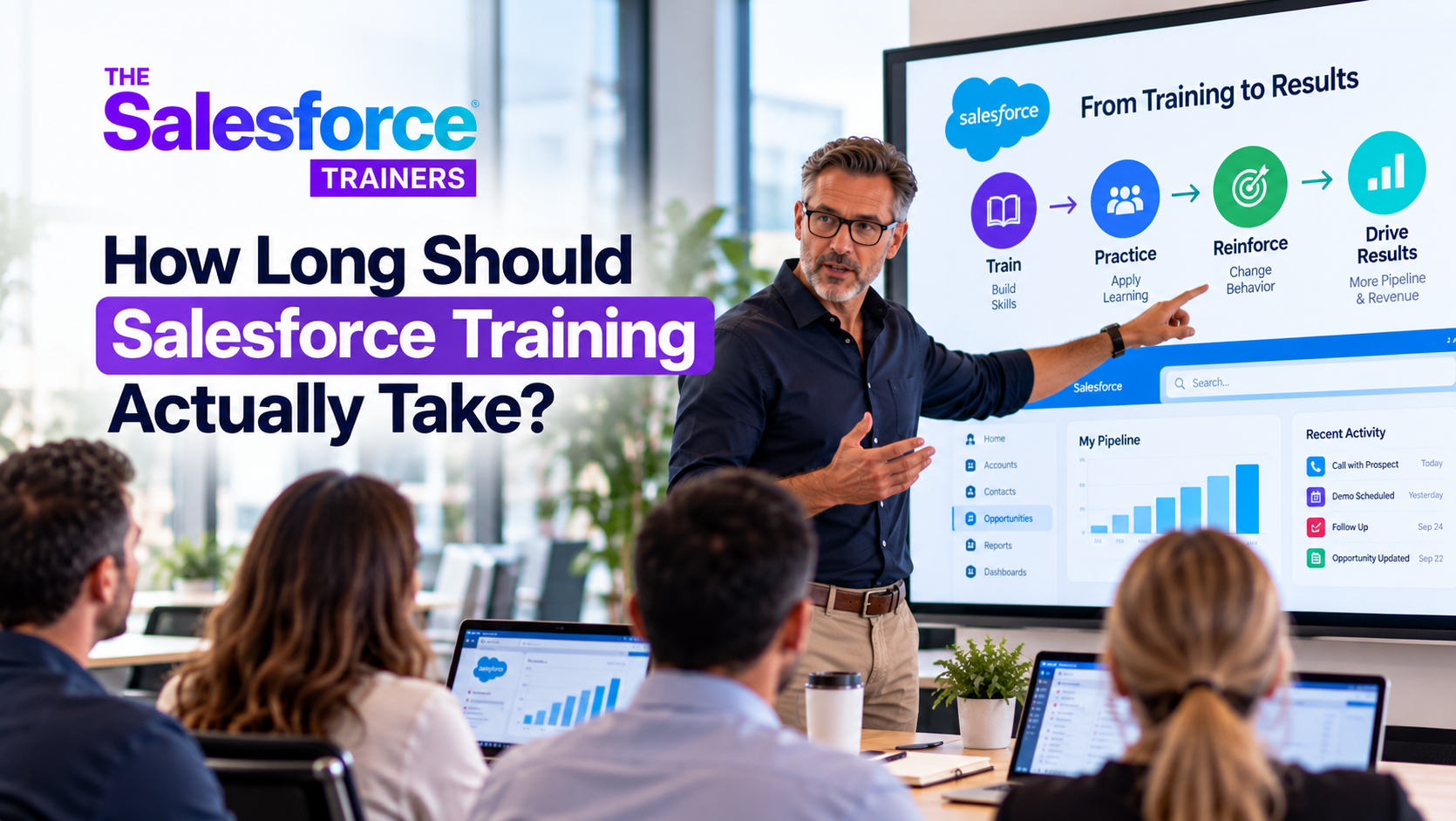
As the original article pointed out, organizations that deliver a training workshop without a reinforcement or follow-up plan can see very little lasting behavioral change.
That's why I don't like thinking about Salesforce training as an event.
Training is an ongoing process.
Your Sales Managers Are Critical
Here's another piece that often gets overlooked.
Who is going to reinforce the behaviors after the trainer leaves?
Not the trainer.
Not the Salesforce administrator.
Not the implementation partner.
Your frontline sales managers.
They're the people having weekly one-on-ones, pipeline reviews, forecast meetings and coaching conversations with your salespeople.
They're the ones who can ask:
"Why isn't this Opportunity updated?"
"What's the next step?"
"Why isn't this deal moving?"
"Did you log that customer meeting?"
"Show me what's happening in your pipeline."
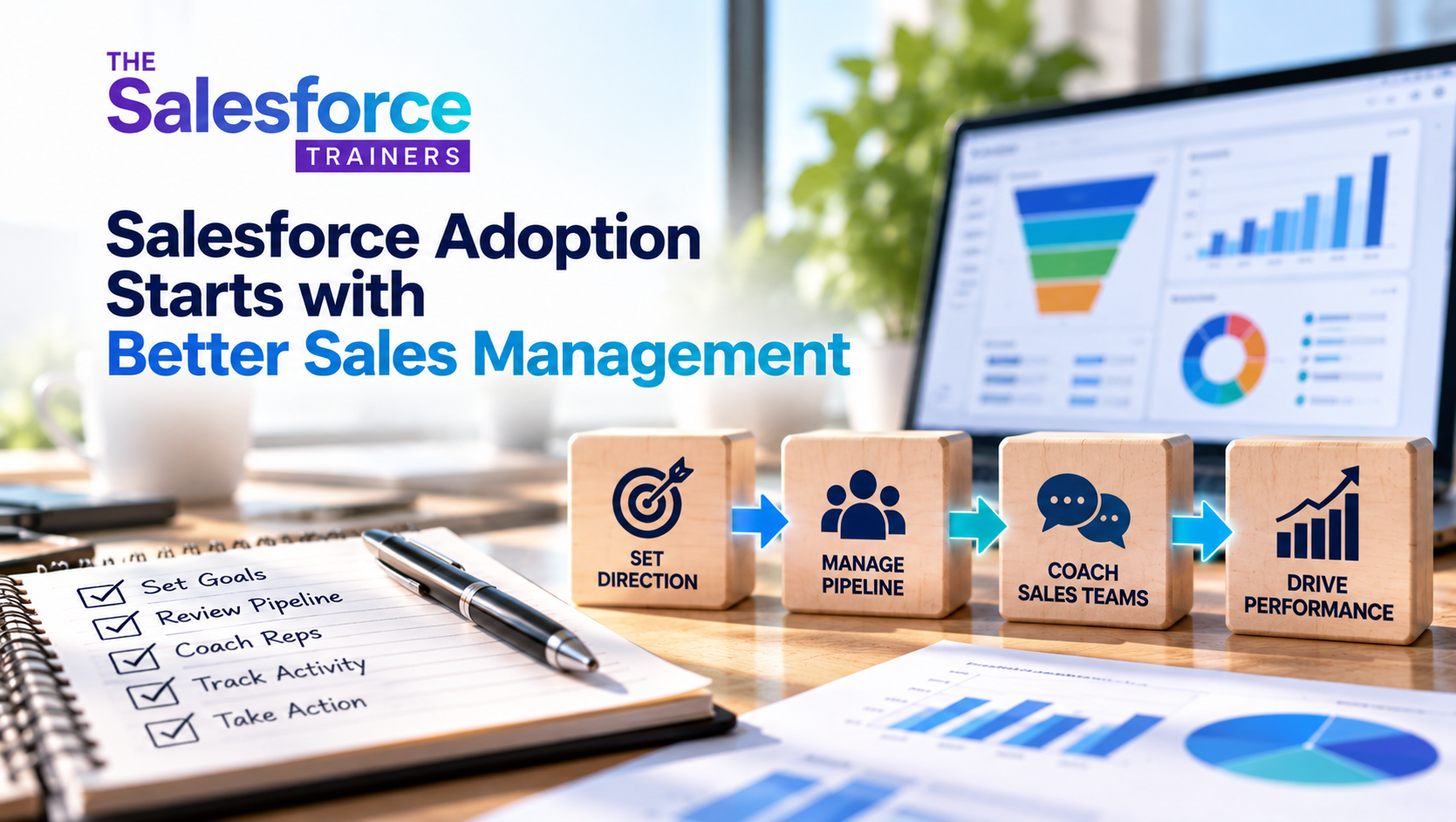
And that's where Salesforce training starts to become sales management.
Your managers need to understand not just how Salesforce works, but how they are expected to use Salesforce to manage their teams.
That's a very different training requirement from teaching an end user where to find a button.
ProSell Salesforce Training & Adoption Program
Your Salesforce Platform Matters Too
There's another reason the answer to “How long should Salesforce training take?” isn't simply a number.
What are you actually asking people to learn?
If your Salesforce platform is well designed and aligned with your sales process, training can focus on the things that matter.
If your platform is cluttered, overly complicated or filled with fields and processes that don't make sense to your salespeople, training becomes much harder.
You can spend hours teaching people where everything is.
But that doesn't mean they'll understand why they should use it.
That's why Salesforce configuration and optimization matter so much to the training experience.
Salesforce Platform Optimization
The better the platform reflects the way your sales organization actually works, the easier it is to train people on it.
Training Can't Fix a Broken Sales Process
This is worth saying again because it comes up constantly.
If your sales process isn't defined, Salesforce training isn't going to fix it.
If your Opportunity stages don't mean anything, training people on how to update the Opportunity won't solve the problem.
If managers don't agree on what constitutes a qualified opportunity, showing salespeople how to enter an Opportunity isn't going to create consistency.
If nobody knows what information should be captured at each stage, adding more training isn't the answer.
You can't train your way out of a process problem.
The process has to be defined first.
Then Salesforce needs to support that process.
Then your people need to understand how to execute it.
That's the Process, Platform and People connection.
Process, Platform and People — The P3 Framework
So What Does a Good Salesforce Training Program Actually Look Like?
Instead of thinking about Salesforce training as one big event, I'd think about it as a progression.
Phase 1: Prepare
Before training begins, make sure the Salesforce environment is ready.
That means:
- The sales process is defined.
- Salesforce is configured to support it.
- Roles and expectations are clear.
- The training content reflects the actual Salesforce environment.
- Managers understand their role.
Phase 2: Train
Give users focused, role-specific training.
Don't try to teach people everything Salesforce can do.
Teach them what they need to know to do their jobs effectively.
For salespeople, that usually means focusing on the parts of Salesforce they'll use every day.
Phase 3: Practice
People need an opportunity to apply what they've learned.
This might involve realistic scenarios, exercises, sandbox practice or working through actual sales situations.
The closer the training is to the salesperson's real job, the more useful it becomes.
Phase 4: Reinforce
This is the phase companies most often skip.
After the initial training, managers need to reinforce the expected behaviors.
That's where coaching, inspection, reporting and regular conversations come in.
Phase 5: Measure Adoption
Finally, you need to know whether the training actually worked.
Are people logging activities?
Are Opportunities being updated?
Are required fields being completed?
Are sales managers using Salesforce in their coaching and pipeline reviews?
Are the behaviors you wanted to change actually changing?
That's how you determine whether your Salesforce investment is producing the outcome you wanted.
Salesforce Adoption & Change Management
The Real Question Isn't How Long Training Takes
So, how long should Salesforce training actually take?
For many sales teams, five or six hours of focused, customized training can provide a strong starting point.
But that's only the starting point.
The real Salesforce adoption effort extends well beyond the training room.
You need the right process.
You need a Salesforce platform that supports that process.
And you need people — particularly sales managers — who are prepared to reinforce the behaviors you want to see.
That's why I wouldn't ask:
"How many hours of Salesforce training do we need?"
I'd ask:
"What will it take to get our salespeople using Salesforce effectively — and continuing to use it six months from now?"
That's a much better question.
Because training teaches people how to use Salesforce.
Adoption is what gets them to actually use it.