
How to Get Your Sales Team to Use Salesforce: 6 Strategies That Work
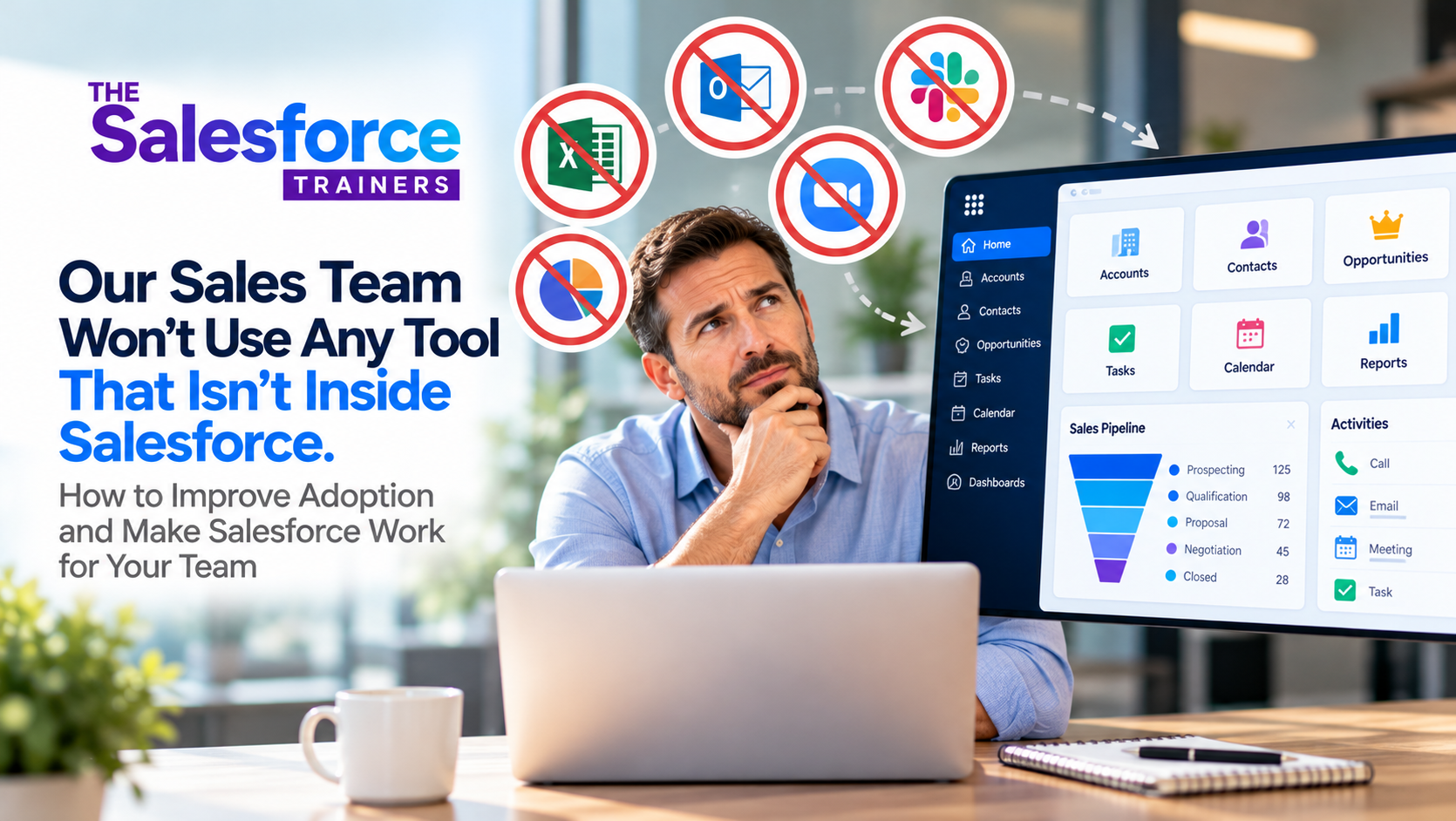
If your sales team won't use any tool that isn't inside Salesforce, you may be looking at the problem the wrong way.
At first, that sounds like a limitation.
Salespeople don't want to jump between applications. They don't want to maintain information in Salesforce and then update another system. They don't want to remember which application contains the latest version of a report, which tool has the prospecting information or where they recorded the last customer interaction.
But there's another way to look at it.
Your sales team is telling you they want Salesforce to be the place where they do their work.
That's actually a pretty good starting point.
The challenge is making Salesforce useful enough that salespeople can rely on it for the work they actually need to do.
That means more than training people on how to create an Opportunity or update a Contact. It means understanding what your salespeople need, configuring Salesforce around their sales process, integrating useful tools where appropriate and making Salesforce part of the way your managers run the business.
Salesforce Adoption Starts With the Sales Manager
It's tempting to think Salesforce adoption is primarily a technology problem.
It's not.
The Salesforce administrator plays an important role. So does IT. So does Sales Operations. Professional training can make a tremendous difference.
But the person with the greatest day-to-day influence over whether salespeople actually use Salesforce is usually the front-line sales manager.
Why?
Because the manager determines what gets discussed in sales meetings, what gets reviewed in one-on-ones, what information salespeople are expected to maintain and what tools are considered part of the sales process.
If the manager runs the pipeline review in Salesforce, salespeople will pay attention to Salesforce.
If the manager asks for an Excel spreadsheet every Friday, they'll build an Excel spreadsheet.
If the manager asks for information that exists in Salesforce but doesn't look at Salesforce, the message is clear: the CRM isn't really the system of record.
Salesforce adoption has to be reinforced through management behavior.
1. Find Out What Your Salespeople Actually Need
Before adding another Salesforce feature, report or application, ask your salespeople what they're trying to accomplish.
What takes too much time?
What information is difficult to find?
What do they currently track outside Salesforce?
What spreadsheets do they maintain?
What tools do they use every day?
Where are they copying information from one system to another?
This exercise can uncover a surprising amount of unnecessary administrative work.
Maybe salespeople are maintaining their own prospect lists.
Maybe they're using spreadsheets to track opportunities.
Maybe they're using another application to manage activities.
Maybe they're keeping customer information in email folders or personal notes.
Don't immediately tell them to stop.
First understand why those tools exist.
If someone built a spreadsheet because Salesforce doesn't give them an easy way to see something they need, the spreadsheet isn't necessarily the problem.
The problem may be the Salesforce experience.
That's why effective Salesforce Platform Optimization starts with understanding how people actually work—not simply adding more functionality to the platform.
2. Make Salesforce the Place Where Salespeople Get Value
Salesforce adoption improves when salespeople get something valuable in return for the information they're putting into the system.
That's the basic exchange.
If salespeople are expected to maintain accurate opportunity information, Salesforce should give them something useful in return.
That might be better pipeline visibility.
It might be easier access to account information.
It might be useful reports.
It might be mobile access to customer information.
It might be automated reminders and follow-up.
It might be better prospecting information.
Or it might simply be eliminating the need to maintain several different spreadsheets.
This is an important distinction.
Don't ask, “How do we get our salespeople to enter more information into Salesforce?”
Ask:
“What can we give salespeople through Salesforce that makes their jobs easier?”
Once you start from that question, adoption becomes much easier to approach.
3. Integrate the Tools Your Sales Team Actually Uses
If your salespeople are already using tools that help them sell, don't automatically assume those tools are competing with Salesforce.
The better question is whether those tools can work with Salesforce.
Salesforce has a broad ecosystem of applications and integrations, and the right tools can extend the platform without forcing salespeople to maintain disconnected systems.
For example, a sales team may use a prospecting tool, email application, meeting scheduler, sales intelligence platform or other productivity technology.
The objective shouldn't necessarily be to eliminate every tool outside Salesforce.
Instead, determine whether the information and workflow can be connected so that the salesperson doesn't have to perform the same work twice.
That's the real enemy of adoption:
duplicate work.
If a salesperson enters information into Salesforce and then has to enter it again somewhere else, or vice versa, you've created unnecessary friction.
If the systems work together and Salesforce remains the central source of customer and opportunity information, the technology becomes much easier to manage.
4. Use Salesforce in Every Sales Meeting
This is one of the simplest—and most effective—ways to reinforce adoption.
Use Salesforce during your sales meetings.
Don't ask everyone to update Salesforce and then conduct the meeting from a spreadsheet.
Don't ask salespeople to maintain their pipeline in Salesforce while management keeps its own version somewhere else.
Use the actual Salesforce pipeline.
Review opportunities.
Discuss forecasts.
Look at stalled deals.
Review top accounts.
Identify opportunities that need attention.
Talk about the information that's missing.
And then coach the salespeople based on what you see.
The first few meetings may not be perfect.
That's okay.
The purpose is to establish a new management rhythm.
Eventually, the message becomes clear:
If we're talking about the sales business, we're talking about the information in Salesforce.
That creates a powerful incentive to keep the information current.
5. Turn Your Salesforce Power Users Into Teachers
Every sales organization has people who figure things out faster than everyone else.
They discover useful reports.
They find shortcuts.
They learn how to organize their pipeline.
They figure out how to get more value from Salesforce.
Don't keep that knowledge isolated.
Use your power users to demonstrate what Salesforce can do for the rest of the team.
Have them show how they use Salesforce to prepare for a meeting.
Show how they manage their pipeline.
Demonstrate a report that saves them time.
Explain how they use Salesforce to prioritize their day.
The most convincing Salesforce training doesn't always come from the trainer.
Sometimes it's another salesperson saying:
“Here's how I use this, and here's how it makes my job easier.”
That creates credibility because the example is coming from someone who understands the reality of selling.
It also reinforces the idea that Salesforce isn't simply something management wants salespeople to use.
It's something successful salespeople can use to work more effectively.
6. Show Executives—and Salespeople—the Value
One of the best ways to reinforce Salesforce adoption is to demonstrate what happens when the organization actually uses the information.
Executives need useful information to make decisions.
Sales managers need useful information to coach their teams.
Salespeople need useful information to manage their opportunities.
Make those connections visible.
Build reports and dashboards that answer real business questions.
Schedule useful reporting for executives.
Give managers visibility into pipeline and performance.
Give salespeople information that helps them prioritize their work.
Then explain how those reports are being used.
When executives can make better resource decisions because Salesforce gives them reliable information, that's value.
When managers can identify a stalled opportunity before it's lost, that's value.
When salespeople can find the information they need without maintaining another spreadsheet, that's value.
The more visible the value becomes, the easier Salesforce adoption becomes.
Don't Confuse Salesforce Adoption With Salesforce Usage
There's another important distinction here.
A salesperson can log into Salesforce every day and still be a poor Salesforce user.
They can also use Salesforce effectively without spending hours inside the application.
The goal isn't to maximize the amount of time salespeople spend in Salesforce.
The goal is to make Salesforce the system that supports the sales process.
That's a much better definition of adoption.
If your salespeople use Salesforce to manage opportunities, prepare for customer interactions, maintain important information and work with their managers, you're moving in the right direction.
If they have to enter the same information into Salesforce, Excel, another CRM and three different sales tools, you haven't created adoption.
You've created administrative work.
Your Salesforce Admin Is an Important Part of the Solution
Sales managers don't have to solve all of this alone.
Your Salesforce administrator can be one of your most valuable resources.
The admin understands what Salesforce can do, what is already configured and what changes may be possible.
So use that expertise.
If you need a better report, ask.
If salespeople are struggling with a particular part of the system, investigate it with your admin.
If a process is unnecessarily complicated, ask whether Salesforce can be configured differently.
If users are maintaining information outside Salesforce, find out whether there is a way to bring that information or workflow into the platform.
And if your sales team wants to use another application, don't automatically say no.
Ask whether there is a Salesforce integration or another way to make the systems work together.
The best Salesforce administrators aren't simply maintaining the technology.
They're helping the business figure out how to make the technology useful.
Adoption Requires More Than Training
Training is important, but training alone doesn't create adoption.
A salesperson can complete a two-day Salesforce class and understand exactly how the system works.
That doesn't mean they'll use it six months later.
For adoption to stick, the sales process has to make sense, the Salesforce configuration has to support that process, managers have to reinforce the behavior and salespeople need to see the value.
That's the philosophy behind our P3 Framework:
Process first. Platform second. People throughout.
The process defines how your sales organization works.
The platform makes that process easier to execute.
And the people—including sales managers—make sure the behavior actually sticks.
What If Your Sales Team Really Won't Use Anything Outside Salesforce?
Then listen to them.
There may be a very good reason.
Maybe they don't want to manage multiple systems.
Maybe they're tired of duplicate data entry.
Maybe they don't trust information stored in different places.
Maybe Salesforce has become the system they rely on and they want everything connected to it.
Those aren't necessarily adoption problems.
They may actually be design requirements.
The opportunity is to make Salesforce the central hub for the sales process while integrating the tools that genuinely add value.
That way, salespeople aren't forced to choose between using Salesforce and using the technology that helps them sell.
They can do both.
And that's ultimately what good Salesforce optimization should accomplish.
Make Salesforce the Place Your Sales Team Wants to Work
If your sales team won't use any tool that isn't inside Salesforce, don't start by fighting that behavior.
Start by asking why.
Find out what they need.
Find out what they're doing outside Salesforce.
Find out where they're creating duplicate work.
Find out which tools actually help them sell.
Then use Salesforce—and the Salesforce ecosystem—to create a sales environment that makes their jobs easier.
That's how you move beyond simply telling people to use Salesforce.
Make Salesforce useful. Make it connected. Make it part of the sales process. And make the value obvious.
When you do that, adoption becomes less about compliance and more about productivity.
And that's the kind of Salesforce adoption that actually lasts.
If you're struggling to get your sales team to use Salesforce consistently, our Salesforce Adoption & Change Management services can help you identify the process, platform and people issues standing in the way.