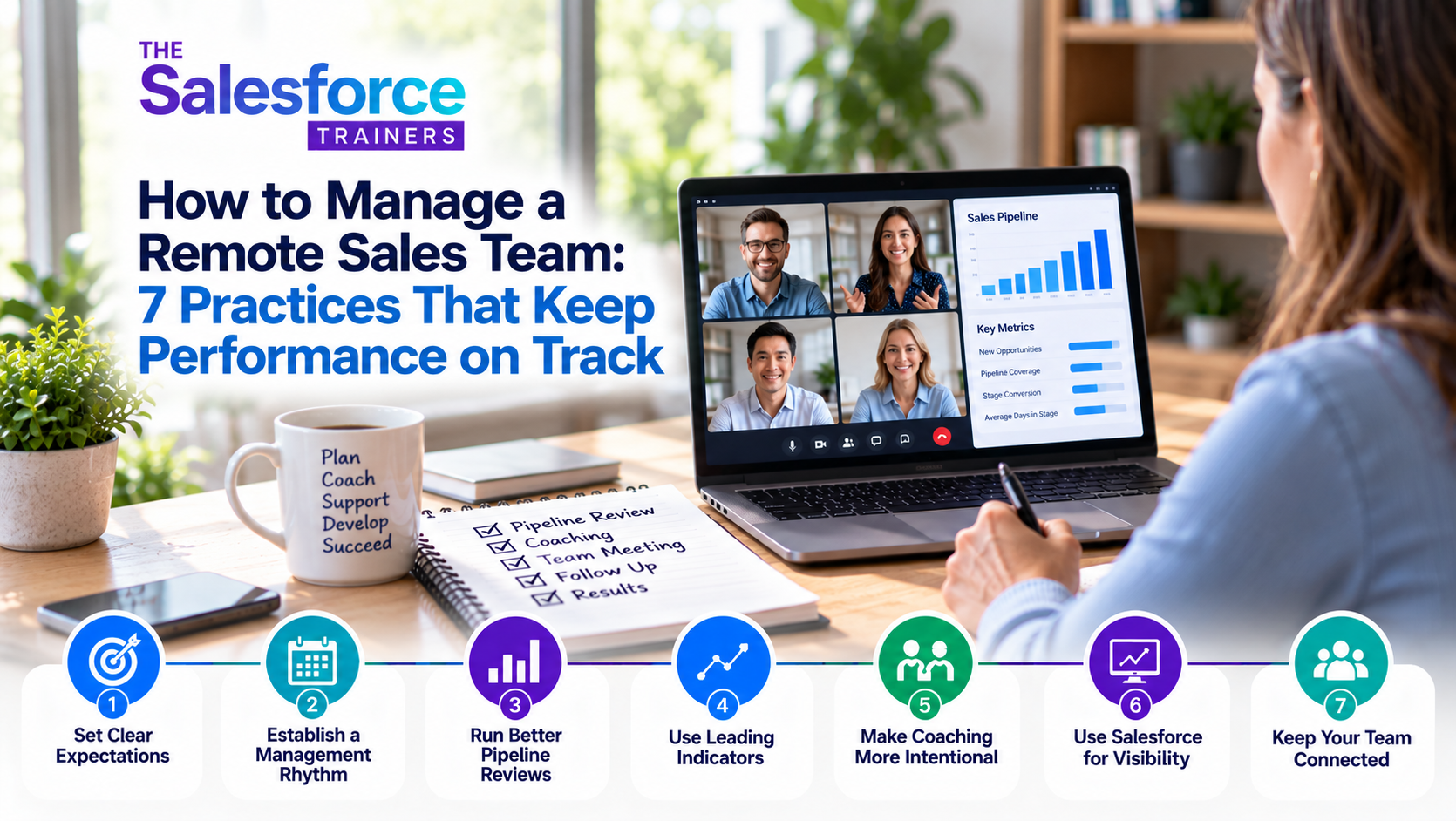
How to Manage a Remote Sales Team: 7 Practices
Managing a remote sales team isn't fundamentally different from managing one in an office. But it exposes weak management practices much faster.
When your team isn't sitting down the hall, you can't rely on informal conversations, overheard discussions or simply seeing who appears busy. Managers need a more deliberate approach to communication, pipeline management, coaching, accountability and performance.
That's not necessarily a disadvantage.
In many cases, managing a remote sales team forces an organization to become better managed.
The key is having the right management practices in place—and using your technology to support them.
Here are seven practices that can help remote sales managers keep their teams focused, accountable and productive.
1. Establish Clear Expectations
One of the biggest challenges with a remote sales team is ambiguity.
When people work in the same office, managers can often resolve small questions quickly. A salesperson can walk over to a manager's desk, overhear how another rep is handling a situation or pick up important information through informal conversations.
Remote teams don't have those same opportunities.
That makes clear expectations even more important.
Managers should establish clear expectations around:
- Sales activities
- Pipeline development
- Opportunity management
- Customer follow-up
- Forecasting
- Communication
- CRM usage
- Performance goals
But there's an important distinction here.
Clear expectations don't mean micromanagement.
A remote sales team doesn't need a manager constantly asking, "What are you doing right now?"
It needs a manager who has clearly defined what good performance looks like and has established a consistent way to measure it.
That starts with a well-defined sales process and clear expectations for how opportunities should move through that process.
When everyone understands the process, managers don't need to constantly monitor activity. They can focus on outcomes, performance and the behaviors that produce those outcomes.
2. Create a Consistent Management Rhythm
Remote sales teams need structure.
That doesn't mean filling everyone's calendar with meetings. In fact, too many meetings can make remote work considerably less productive.
Instead, establish a predictable management rhythm.
For example:
Weekly: Conduct structured pipeline reviews and identify opportunities that require attention.
Biweekly: Hold individual coaching conversations focused on performance, development and deal strategy.
Monthly: Review leading indicators, pipeline trends, conversion rates and forecast accuracy.
Quarterly: Evaluate overall sales effectiveness, identify systemic issues and adjust priorities.
The exact cadence will depend on your sales cycle, team size and business model.
The important thing is consistency.
When managers establish a predictable rhythm, salespeople know when they'll receive feedback, when their pipeline will be reviewed and when performance will be discussed.
That reduces uncertainty and makes management more proactive.
It also creates a natural role for Salesforce.
Instead of asking salespeople to update Salesforce simply because management wants better data, managers can use Salesforce as the information source for the conversations they're already having.
The CRM becomes part of the management rhythm rather than another administrative task.
3. Make Pipeline Reviews About Decisions—Not Data Entry
Remote sales management can quickly turn into a reporting exercise.
Managers schedule a video call. Everyone opens their CRM. The team goes through the opportunities one by one. The manager asks for updates. The salesperson provides them. Then everyone moves on to the next deal.
That's not really pipeline management.
It's data collection.
A productive pipeline review should help managers answer questions such as:
- Which opportunities are most likely to close?
- Which deals are at risk?
- Where are opportunities getting stuck?
- Which opportunities don't actually meet the criteria for their current stage?
- Where does the salesperson need help?
- Which deals require management intervention?
- Is there enough qualified pipeline to support future targets?
The objective isn't to inspect every field in Salesforce.
The objective is to make better decisions about the pipeline.
That requires a consistent definition of what constitutes a qualified opportunity, meaningful stage criteria and clear expectations for what information should be available before a deal progresses.
If your pipeline reviews aren't producing decisions and actions, it may be time to rethink the process rather than simply adding another dashboard.
Our Salesforce Platform Optimization work focuses on configuring Salesforce to support the way your sales organization actually operates, rather than forcing managers to work around the technology.
4. Manage With Leading Indicators, Not Just Results
One of the biggest mistakes sales managers can make—whether their team is remote or not—is managing primarily through lagging indicators.
Revenue, bookings, quota attainment and closed deals are important.
But by the time those numbers tell you there's a problem, it may be too late to do anything about it.
Remote sales teams make the need for leading indicators even more important because managers have fewer opportunities to observe what's happening informally.
Instead, identify the handful of indicators that provide an early signal of future performance.
Depending on your sales model, those might include:
- Qualified opportunities created
- Pipeline coverage
- Opportunity progression
- Stage conversion
- Time spent in each stage
- Opportunities with defined next steps
- Meaningful customer engagement
- New pipeline generated by each salesperson
The objective isn't to measure everything.
It's to identify the few indicators that actually help managers predict and influence future results.
Once those indicators are defined, Salesforce can provide managers with visibility into them through reports and dashboards.
But again, the technology comes second.
First determine what you need to manage. Then determine how Salesforce can help you see and act on it.
That's one of the fundamental principles behind our P3 Framework: Process first. Platform second. People throughout.
5. Make One-on-One Coaching More Intentional
Remote work can make informal coaching more difficult.
In an office, a manager might overhear a salesperson preparing for a call, notice that someone is struggling with a particular customer or have an impromptu conversation about a difficult opportunity.
Those moments happen less naturally when everyone works remotely.
That means managers need to become more intentional about coaching.
A one-on-one shouldn't simply be a status update.
It should be an opportunity to understand what's happening, identify obstacles and help the salesperson improve.
Salesforce can provide useful context for those conversations.
For example, a manager might notice that a salesperson is generating plenty of opportunities but consistently struggles to move them beyond the early stages.
That could lead to a coaching conversation about qualification, customer engagement, access to decision-makers or the salesperson's approach to advancing opportunities.
Another salesperson might have strong opportunity progression but consistently struggle to close deals.
That's a different coaching problem.
The point isn't to use Salesforce to find fault.
It's to use the information available to identify patterns and have better conversations.
And managers need the skills to do that effectively.
A dashboard can identify a performance gap.
It takes a manager to understand why the gap exists and help the salesperson close it.
6. Use Salesforce to Create Visibility Without Micromanaging
Remote work can create anxiety for managers.
You can't see your team working. You don't know who is on the phone, who is preparing for a customer meeting or who is spending the afternoon researching a prospect.
The temptation is to compensate by measuring more activity.
More calls.
More emails.
More CRM updates.
More activity reports.
That can quickly become counterproductive.
Activity isn't the same thing as productivity.
A salesperson can make 50 calls and accomplish very little. Another might have three important customer conversations that materially advance a major opportunity.
The manager's job isn't to create an environment where everyone has to prove they're busy.
It's to create visibility into the activities and outcomes that actually matter.
Salesforce can help with that.
Used properly, it gives managers visibility into pipeline health, opportunity progression, customer activity and performance trends without requiring managers to constantly check on individual employees.
This is where good Salesforce adoption and change management becomes important.
People are much more likely to maintain accurate information when they understand why the information matters and see their managers using it productively.
If Salesforce is primarily used to police activity, adoption becomes a compliance exercise.
If it's used to help managers coach, forecast, prioritize and make decisions, it becomes part of how the business operates.
7. Keep Remote Salespeople Connected to the Team
Sales is competitive.
It's also highly social.
When everyone works together in an office, much of the social interaction happens naturally. People exchange ideas, celebrate wins, ask each other questions and learn from what's happening around them.
Remote teams have to be more deliberate about creating those connections.
That doesn't mean scheduling endless virtual happy hours.
It means creating regular opportunities for salespeople to share what's working, discuss challenges and learn from each other.
For example:
- Share successful customer approaches during team meetings.
- Discuss important wins and what contributed to them.
- Have salespeople share lessons from lost opportunities.
- Encourage peer-to-peer problem solving.
- Recognize accomplishments publicly.
- Create opportunities for newer salespeople to learn from experienced reps.
Managers should also pay attention to morale.
Not because everyone needs to be constantly entertained, but because people perform better when they understand how their work contributes to the organization's goals and feel connected to their team.
Remote sales management isn't simply about keeping people busy.
It's about creating an environment where people can perform.
Don't Confuse Remote Management With Remote Monitoring
There's an important distinction running through all seven of these practices.
Managing a remote sales team doesn't mean finding better ways to watch people.
It means finding better ways to manage performance.
That requires clear expectations, a defined sales process, consistent management routines, meaningful metrics and effective coaching.
Technology can help make those things possible.
It can't replace them.
If your management philosophy is essentially, "How can I know what everyone is doing when I can't see them?", you're likely heading toward a culture of surveillance.
A better question is:
"What information do I need to effectively manage performance, and how can I make that information available?"
That's a very different approach.
And it's one that benefits both managers and salespeople.
Remote Work Can Expose Weak Sales Management
One of the unexpected benefits of managing a remote team is that it can expose weaknesses that were already there.
If pipeline reviews were inconsistent before, remote work makes that inconsistency more obvious.
If managers weren't coaching effectively before, the problem becomes harder to hide.
If your sales process wasn't clearly defined, remote teams can make the resulting confusion even more apparent.
If your CRM wasn't providing useful management information, simply giving managers more dashboards won't solve the problem.
The answer isn't necessarily more technology.
Sometimes the answer is to go back to the basics.
Define the process. Establish the management practices. Then configure the technology to support them.
That's the foundation of effective sales management whether your team works in an office, remotely or somewhere in between.
The P3 Framework: Process First. Platform Second. People Throughout.
At The Salesforce Trainers, we approach sales performance and Salesforce effectiveness through our P3 Framework: Process, Platform and People.
The concept is straightforward.
Process: Define how your sales organization should operate. Establish the sales process, qualification criteria, pipeline management practices, forecasting expectations and management rhythm.
Platform: Configure Salesforce to support those processes. Give managers the visibility and information they need without creating unnecessary administrative work for salespeople.
People: Equip managers and salespeople with the skills and behaviors required to execute the process and use the platform effectively. Reinforce those behaviors through coaching, training and change management.
The sequence matters.
If you start with the technology, you can end up building dashboards without a management purpose.
If you start with training, you can teach people how to use Salesforce without giving them a compelling reason to use it.
But when the process is defined first, Salesforce can become a powerful management tool—and your people understand how it fits into the way they work.
The Goal Isn't to Manage Remotely. It's to Manage Effectively.
Whether your sales team is 100% remote, hybrid or back in the office, the fundamentals of good sales management haven't changed.
Salespeople need clear expectations.
Managers need visibility.
Pipelines need structure.
Coaching needs to be consistent.
And organizations need a reliable way to identify performance issues early enough to do something about them.
Remote work simply makes those requirements harder to ignore.
If you're managing a remote sales team and struggling with accountability, pipeline visibility or performance, don't start by asking which new technology you need.
Start by asking whether your management process is clearly defined.
Do your managers have a consistent pipeline review process?
Do they know which leading indicators to monitor?
Are one-on-one conversations focused on coaching rather than status updates?
Is Salesforce helping managers make better decisions?
Are salespeople clear about what good performance looks like?
If the answers aren't clear, the solution may not be another dashboard, another report or another round of CRM training.
It may be time to improve the management system that Salesforce is supposed to support.
Good remote sales management isn't about watching people more closely. It's about giving managers the process, information and skills they need to lead effectively.
And when that happens, your sales team doesn't need to be sitting in the same office to perform at a high level.